
In this article
- What Is a Sleep Study?
- Why You Might Be Referred for a Sleep Study
- What a Sleep Study Measures
- The Three Types of Sleep Apnoea
- Levels of Sleep Study — Level 1, 2 and 3
- Other Types of Sleep Testing
- Sleep Lab vs Home Sleep Test
- Understanding Your AHI Score
- Do You Need a Sleep Study? The STOP-BANG Screen
- What Happens on the Night
- Are There Any Risks?
- When DISE Is Needed
- After Your Results
- Sleep Care at THANC
- Frequently Asked Questions
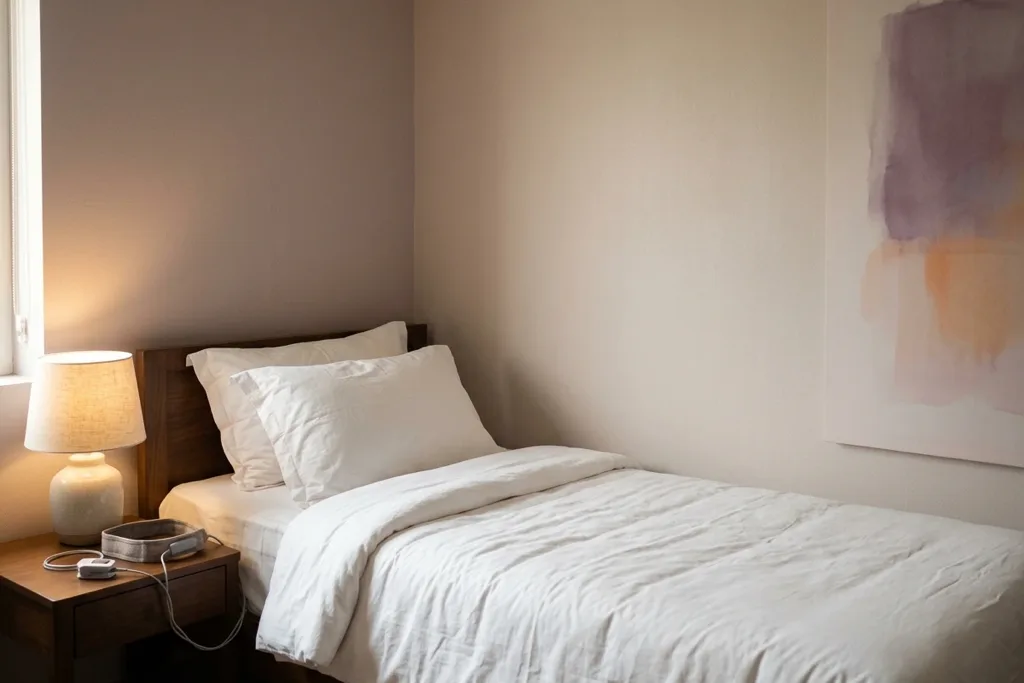
What Is a Sleep Study?
A sleep study — medically called polysomnography — records what your body does while you sleep. It is the test that confirms or rules out obstructive sleep apnoea, and it is the single most useful investigation in sleep medicine.
Snoring alone cannot tell you whether you have sleep apnoea. Neither can daytime tiredness, a partner's description, or how you feel in the morning. Only a sleep study measures what actually happens to your breathing overnight.
The test is painless. Nothing is injected, nothing goes inside your body, and you are not sedated. Sensors are placed on the skin and you sleep as normally as you can.
Why You Might Be Referred for a Sleep Study
Sleep stages range from light to deep, and each has characteristics that can be measured. A sleep study runs several tests at the same time to capture them. Common reasons for referral include:
- Excessive snoring
- Sleep apnoea — witnessed periods where breathing stops
- Daytime sleepiness that is not explained by short sleep
- Insomnia — persistent inability to fall or stay asleep
- Narcolepsy — sudden, uncontrollable onset of sleep
- Restless legs syndrome — uncomfortable leg sensations that disrupt sleep
Less common conditions may also warrant testing: sleep terrors (nightmares during non-dream stages of sleep), sleepwalking or sleep talking, and REM sleep behaviour disorder, in which people physically act out their dreams. Your doctor may have other reasons specific to your case.
What a Sleep Study Measures
Several body systems are recorded at once, which is why the word polysomnography (many measurements) is used:
| What is recorded | Why it matters |
|---|---|
| Airflow at nose and mouth | Detects pauses and reductions in breathing |
| Chest and abdominal movement | Distinguishes obstructive from central events |
| Blood oxygen (SpO₂) | Shows how far oxygen drops during events |
| Brain activity (EEG) | Identifies sleep stages and arousals |
| Heart rhythm (ECG) | Detects rhythm changes linked to apnoea |
| Leg movements | Picks up periodic limb movement disorder |
| Body position | Shows whether events happen mainly on your back |
| Snoring sound | Records intensity and pattern |
Position matters more than most people expect. Some patients have significant apnoea only when sleeping on their back — a finding that changes treatment entirely.
The Three Types of Sleep Apnoea
Before looking at the test, it helps to know what it is looking for. Not all sleep apnoea has the same mechanism, and the distinction changes treatment completely.
Obstructive sleep apnoea (OSA) is by far the most common. The soft tissue at the back of the throat relaxes during sleep and blocks the airway. The effort to breathe continues — the chest and abdomen keep working against a closed airway — which is why it is strongly associated with snoring.
Central sleep apnoea is uncommon. Here the airway is open, but the brain intermittently fails to signal the muscles that control breathing. Because there is no obstruction to vibrate against, snoring is not typical. Central events point toward a neurological or cardiac cause rather than an airway one.
Complex (mixed) sleep apnoea is a combination of both obstructive and central events in the same patient.
This is precisely why chest and abdominal movement are recorded. A pause with continued breathing effort is obstructive; a pause with no effort at all is central. A home device that measures airflow but not effort can miss that distinction — one of the main reasons an in-lab study is preferred when central apnoea is suspected.
Levels of Sleep Study — Level 1, 2 and 3
Sleep studies are formally graded by how much they monitor and where they are performed. If your referral or report mentions a "level", this is what it means.
| Level 1 | Level 2 | Level 3 | |
|---|---|---|---|
| Where | Sleep lab only | Home, or sometimes lab | Home |
| Technologist watching live | Yes — throughout | No | No |
| Breathing, oxygen, heart rate | Yes | Yes | Yes |
| Brain and muscle activity (EEG/EMG) | Yes | Yes | No |
| Sleep staging and quality | Yes | Yes | No |
| Limb movement / PLMD | Yes | Yes | No |
| Can diagnose REM sleep behaviour disorder | Yes | No | No |
A level 3 study — commonly called a home sleep apnoea test (HSAT) — is done in your own bed rather than a lab. The kit records breathing activity, oxygen levels and heart rate through the night, testing snoring and airflow to diagnose obstructive sleep apnoea. It is the right tool for a straightforward suspected OSA case, and the wrong tool for anything else.
A level 2 study is full polysomnography that can also be completed at home, though some are offered in a lab. On top of breathing, oxygen and heart rate, it monitors brain and muscle activity. That extra channel makes it a considerably more sensitive test: it can track leg and body movement, detect periodic limb movement disorder (PLMD), and give a genuine analysis of the overall quality and length of your sleep rather than just your breathing.
A level 1 study is identical in what it measures to a level 2, with one crucial difference — it takes place in a sleep lab and is observed in real time by a Registered Polysomnographic Technologist (RPSGT). Aside from the ability to diagnose REM sleep behaviour disorder, the monitoring and testing capabilities do not differ between level 2 and level 1.
The practical takeaway: a level 3 test answers "do I have obstructive sleep apnoea, and how bad is it?" A level 1 or 2 study answers "what is actually happening during my sleep?" — which is the question that matters when the picture is unclear or a non-respiratory sleep disorder is suspected.
Other Types of Sleep Testing
Polysomnography is the best known, but it is not the only sleep test.
Multiple Sleep Latency Test (MSLT) measures how quickly you fall asleep, and how quickly you enter REM sleep, during a series of daytime naps. It is used chiefly to investigate excessive daytime sleepiness that may be due to narcolepsy or idiopathic hypersomnia. It is performed the day after an overnight study.
CPAP titration determines how much air pressure you actually need from a CPAP machine, so the device can be programmed correctly for home use. This normally requires a second night in the lab. Where sleep apnoea is strongly suspected in advance, a split-night study can be an efficient alternative — polysomnography diagnoses the apnoea during the first half of the night, and CPAP titration is carried out during the second half.
Sleep Lab vs Home Sleep Test
Two formats exist, and they are not interchangeable.
In-lab polysomnography is done overnight in a sleep lab. A technician applies the sensors and monitors the recording through the night. It captures brain activity and sleep staging, so it detects arousals and non-respiratory sleep disorders that a home device cannot.
A home sleep apnoea test uses a smaller device you take home and wear in your own bed. It records breathing, oxygen and heart rate, but usually not EEG — so it cannot measure sleep stages or confirm how long you were actually asleep.
| In-lab study | Home test | |
|---|---|---|
| Brain activity / sleep staging | Yes | Usually not |
| Detects central apnoea reliably | Yes | Limited |
| Detects limb movements, parasomnias | Yes | No |
| Sleep in your own bed | No | Yes |
| Best for | Uncertain or complex cases, other sleep disorders suspected, prior normal home test | Straightforward suspected OSA in an otherwise healthy adult |
A home test that comes back normal does not rule out sleep apnoea if symptoms are strong — it under-estimates severity when you sleep poorly with the device. In that situation an in-lab study is the correct next step.
Understanding Your AHI Score
The headline number on your report is the AHI — Apnoea-Hypopnoea Index. It is the average number of times per hour that your breathing stopped (apnoea) or became significantly shallow (hypopnoea).
| AHI (adults) | Severity |
|---|---|
| Under 5 | Normal |
| 5 – 15 | Mild |
| 15 – 30 | Moderate |
| Over 30 | Severe |
Thresholds differ in children, where an AHI above 1 is already abnormal — one reason paediatric sleep-disordered breathing is assessed differently.
Three other numbers matter:
- Oxygen nadir — the lowest oxygen level reached. Someone with moderate AHI but oxygen dropping into the 70s may need more urgent treatment than the AHI alone suggests.
- ODI (Oxygen Desaturation Index) — how many times per hour your oxygen fell by 3–4% below baseline. It shows how often the events actually cost you oxygen.
- Supine AHI — your AHI while on your back. If it is far higher than your overall AHI, positional therapy may help considerably.
An apnoea is a complete pause of 10 seconds or more; a hypopnoea is a partial blockage reducing airflow by at least 30% with an oxygen drop or arousal. Both count toward your AHI.
AHI is not the whole picture. Two people with an AHI of 20 can need different treatment depending on oxygen levels, symptoms, blood pressure and heart health.
Do You Need a Sleep Study? The STOP-BANG Screen
STOP-BANG is a widely used screening questionnaire. It does not diagnose anything — it estimates whether testing is worthwhile.
- S — Snoring loudly?
- T — Tired during the day?
- O — Observed to stop breathing during sleep?
- P — Pressure: treated for high blood pressure?
- B — BMI over 35?
- A — Age over 50?
- N — Neck circumference over 40 cm?
- G — Gender: male?
Roughly: 0–2 yes = low risk; 3–4 = intermediate; 5–8 = high risk, and a sleep study is clearly indicated.
Consider testing regardless of score if you have loud habitual snoring, witnessed breathing pauses, unrefreshing sleep, morning headaches, difficult-to-control blood pressure, or you feel sleepy while driving.
What Happens on the Night
For an in-lab study at our sleep lab in Kilpauk:
- Arrive in the evening, usually around 8–9 pm, with your usual night clothes and medication. You will change into pyjamas or a hospital gown and remove jewellery or anything that might interfere with the sensors.
- Sensor placement takes 45–60 minutes. The technologist measures the dimensions of your head and marks the spots on your scalp and face where electrodes attach — the marks wash off with soap and water. A cotton swab applies a mildly abrasive paste to each spot to remove skin oil so the electrodes adhere properly.
- You sleep. Most people sleep less well than at home; that is expected and does not invalidate the test. You can turn over, and staff will help if you need the bathroom.
- Morning removal, typically by 6–7 am. There is no recovery period — go straight to work if you wish. You may be asked to complete a short questionnaire about how well you felt you slept, and you can eat, drink and take your regular medication immediately.
- Report and consultation. Raw data is scored and interpreted, and results are explained alongside your symptoms.
What Gets Attached, and Why
| Sensor | What it records |
|---|---|
| Scalp and facial electrodes (EEG) | Brain activity and sleep staging |
| Electrodes near the eyes (EOG) | Eye movements, which identify REM sleep |
| Flat plastic microphone taped to the neck | Snoring intensity and pattern |
| Sticky pads on the chest (ECG) | Heart rhythm |
| Stretchy cloth belts across chest and abdomen | Breathing effort |
| Pads on shins or forearms (EMG) | Muscle and limb movements |
| Finger clip (pulse oximeter) | Continuous blood oxygen saturation |
| Nasal cannula and thermistor | Airflow and nostril temperature change |
All of these connect to a small portable box you can carry with you if you need to get out of bed during the night — you are not tethered to the bed. The nasal cannula goes in last, just before lights out, and monitoring begins before you fall asleep. If you already use CPAP, you may be fitted with your mask.
Some facial wires are taped in place. If you are sensitive or allergic to medical tapes or glues, tell the technologist in advance so an alternative can be used.
Preparing for the Night
Before scheduling, speak to your doctor about your medications — some can interfere with sleep study results, but never skip a dose without medical advice first. If the idea of sleeping in a clinic makes you anxious, you can request a tour of the sleep lab beforehand, or ask about having someone accompany you for the set-up.
On the day itself: follow your usual daily routine as closely as you can, avoid caffeine from the afternoon onward, do not take a nap, and wash any gel, oil or styling product out of your hair — these interfere with electrode contact and degrade the recording.
Are There Any Risks?
There are no known risks from a sleep study beyond possible mild skin irritation where the electrodes are attached. Nothing is inserted, no sedation is used for a standard study, and there is no radiation or injection involved.
When DISE Is Needed
A sleep study tells you how severe the obstruction is. It does not tell you where it is happening — and that matters if surgery is being considered.
Drug-induced sleep endoscopy (DISE) answers the "where". Under light sedation that mimics natural sleep, a flexible endoscope views the airway while you are actually obstructing. It shows whether collapse is at the soft palate, the tonsils, the tongue base, or several levels together.
Findings are usually recorded using the VOTE classification, which grades collapse at four levels:
| Level assessed | |
|---|---|
| V | Velum — soft palate and uvula |
| O | Oropharynx — tonsils and side walls of the throat |
| T | Tongue base |
| E | Epiglottis |
Many patients collapse at more than one level, which is precisely why single-site surgery sometimes disappoints.
This is what makes surgery targeted rather than speculative. Palate surgery will not solve tongue-base collapse, and the reverse is equally true. DISE findings guide the choice between uvulopalatopharyngoplasty, tongue base reduction, jaw advancement surgery, or a combination.
DISE is usually recommended when CPAP has not been tolerated and surgical alternatives are being planned.
After Your Results
- AHI under 5 with symptoms — the cause may be simple snoring without apnoea, positional, or another sleep disorder.
- Mild OSA — weight management, positional therapy, treating nasal obstruction, and an oral appliance are often tried first.
- Moderate to severe OSA — CPAP is usually first-line. Where it is not tolerated, DISE-guided sleep apnoea surgery is the alternative.
Untreated moderate-to-severe sleep apnoea is linked to hypertension, heart rhythm problems, stroke, poor diabetic control and road-traffic accidents. Testing is worth doing.
Sleep Care at THANC
Sleep medicine at THANC is led by Dr. Mahalakshmi Rangabashyam Shetty, MBBS, DipNB (ENT), MRCS (ENT) Edinburgh — Senior Consultant and Sleep Lead, Department of Sleep Health. Her practice covers snoring, obstructive sleep apnoea and circadian sleep disorders, using sleep studies and DISE-guided assessment to match treatment to the individual airway.
Because sleep-disordered breathing often involves the nose, palate, tongue base or jaw together, assessment is shared across the sleep and snoring service, ENT, and oral & maxillofacial surgery — so the diagnosis leads to the right treatment rather than the most available one.
Book a consultation to discuss whether a sleep study is right for you.
Frequently Asked Questions
What is a sleep study and what does it measure?
A sleep study, or polysomnography, records your breathing, blood oxygen, brain activity, heart rhythm, leg movements, body position and snoring while you sleep. It is the definitive test for diagnosing obstructive sleep apnoea and measuring its severity.
Is a home sleep test as good as a sleep lab study?
For straightforward suspected obstructive sleep apnoea in an otherwise healthy adult, a home test is often sufficient. An in-lab study is better when the picture is unclear, another sleep disorder is suspected, or a home test was normal despite strong symptoms — because home devices do not record brain activity and can under-estimate severity.
What does my AHI score mean?
AHI is the number of breathing pauses or significant reductions per hour of sleep. Under 5 is normal, 5–15 is mild, 15–30 is moderate and above 30 is severe. Your oxygen nadir and supine AHI matter too — the headline number alone does not determine treatment.
Does a sleep study hurt?
No. Sensors are placed on the surface of the skin with tape or clips. Nothing is inserted and no sedation is used for a standard study. Most people find the sensors mildly unfamiliar rather than uncomfortable.
What if I cannot sleep during the test?
This is very common and rarely a problem. The study needs only a few hours of recorded sleep to produce a valid result. Reports account for how long you actually slept, and staff can help if you are struggling.
Do I need a sleep study before sleep apnoea surgery?
Yes. Surgery is not planned without an objective measurement of severity, and in most cases DISE is also performed to identify exactly where the airway collapses. Operating without knowing the level of obstruction risks treating the wrong site.
How soon will I get my results?
The recording is scored by a technologist and interpreted by a sleep physician, so results are typically discussed within a few days of the study rather than the same morning.
What is the difference between a level 1, level 2 and level 3 sleep study?
A level 3 study is a home sleep apnoea test recording breathing, oxygen and heart rate only — enough to diagnose obstructive sleep apnoea. A level 2 study adds brain and muscle activity, so it can stage your sleep and detect limb movement disorders, and can be done at home or in a lab. A level 1 study measures the same things as a level 2 but is performed in a sleep lab under live observation by a registered polysomnographic technologist, and is the only level that can diagnose REM sleep behaviour disorder.
What is the difference between obstructive and central sleep apnoea?
In obstructive sleep apnoea the airway is physically blocked by relaxed throat tissue while the body keeps trying to breathe — snoring is typical. In central sleep apnoea the airway is open but the brain briefly stops signalling the breathing muscles, so snoring is usually absent. Complex sleep apnoea is a combination of the two. A sleep study distinguishes them by recording breathing effort alongside airflow.
Are there any risks or side effects from a sleep study?
No. The only recognised issue is possible mild skin irritation where electrodes are taped to the skin. Nothing is inserted into the body, no sedation is given for a standard study, and there is no radiation involved.
Will I need a second night for CPAP titration?
Sometimes. CPAP titration establishes the exact air pressure your machine should deliver, and this often requires a second study. If sleep apnoea is strongly suspected beforehand, a split-night study can avoid that — apnoea is diagnosed in the first half of the night and pressure is titrated in the second half.
Learn more about Sleep & Snoring Clinic
View treatments, doctors & FAQs
Concerned about this condition?
Our specialists can help. Book a consultation today.
Book Consultation
MBBS, DipNB (ENT), MRCS (ENT) Edinburgh
Senior Consultant & Sleep Lead, Department of Sleep Health