
In this article
- What Is an Oral Appliance for Sleep Apnea?
- How Does a Mandibular Advancement Device Work?
- Who Is the Ideal Candidate for an Oral Appliance?
- What to Expect During the Custom Fitting Process
- Potential Side Effects and Adjustments of Oral Appliances
- Oral Appliance vs. CPAP: Key Differences Explained
- When Is Surgery a Better Option Than a Sleep Apnea Mouthpiece?
- Comparing Your Options: Oral Appliances, CPAP, and Surgical Routes
- What Is Combination Therapy for Obstructive Sleep Apnea?
- How We Determine Your Best Sleep Apnea Treatment in Chennai
- Related Reading
- Frequently Asked Questions
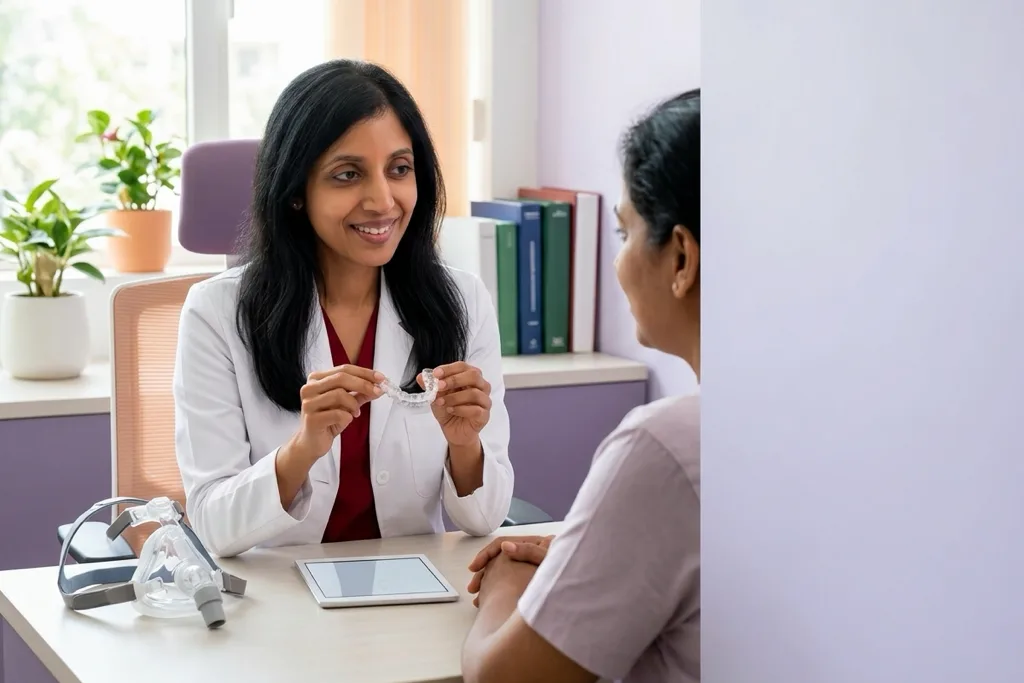
Sleep deprivation and chronic snoring can significantly disrupt your quality of life, often pointing to the presence of obstructive sleep apnea (OSA). While Continuous Positive Airway Pressure (CPAP) remains a common standard of care, many patients struggle with its bulky mask and constant air pressure, making an oral appliance for sleep apnea an increasingly popular, highly effective, and non-invasive alternative. This comprehensive guide explores how custom-fit mouthguards can restore your sleep, prevent airway collapse, and offer a comfortable pathway to long-term health.
What Is an Oral Appliance for Sleep Apnea?
An oral appliance for sleep apnea is a specialized, medically regulated device worn in the mouth during sleep to prevent the tissues of the throat from collapsing and blocking the airway. Unlike general dental retainers, these appliances are highly engineered clinical instruments designed to address the specific structural causes of obstructive sleep apnea. They serve as a primary non-invasive treatment option for patients who experience disrupted breathing patterns, frequent nighttime awakenings, and daytime fatigue.
The Role of Mandibular Advancement Devices
Among the various types of oral appliances, the Mandibular Advancement Device (MAD) is the most widely utilized and clinically validated. A MAD looks similar to a sports mouthguard or an orthodontic retainer, but it features a unique dual-arch design that fits over both the upper and lower teeth.
The primary role of a MAD is to gently but firmly reposition the lower jaw (mandible) forward. By shifting the jaw, the device pulls the base of the tongue and the surrounding soft tissues away from the back of the throat. This mechanical shift keeps the upper airway open and stable throughout the night, reducing the frequency of apneas (complete pauses in breathing) and hypopneas (partial airway obstructions). For patients diagnosed with mild-to-moderate OSA, these devices offer a highly reliable way to stabilize breathing without the need for pressurized air.
Custom-Fit vs. Over-the-Counter Mouthguards
It is critical to distinguish between professional, custom-fit sleep apnea appliances and cheap, over-the-counter (OTC) "boil-and-bite" snoring mouthguards. While OTC devices are easily accessible online or at local pharmacies, they are not cleared or designed to treat obstructive sleep apnea.
- Custom-Fit Appliances: These are fabricated in a specialized dental laboratory using precise digital impressions or physical molds of your teeth. They are constructed from durable, biocompatible medical-grade polymers and feature adjustable hinges or calibrated connectors. This allows for precise, millimeter-level titration (adjustment) of the jaw position. They distribute forces evenly across the entire dental arch, protecting your teeth and the temporomandibular joint (TMJ) from damage.
- Over-the-Counter Mouthguards: OTC devices are made from soft plastics that soften in hot water. They provide a sloppy, generic fit that frequently slips out of place during the night. Because they cannot be adjusted incrementally, they often fail to advance the jaw sufficiently to clear the airway. More importantly, the uneven pressure they exert can cause permanent tooth movement, severe jaw pain, and damage to the TMJ.
In modern sleep medicine, custom oral appliances are integrated into a multi-disciplinary toolkit alongside positive airway pressure devices and surgical interventions, ensuring that every patient has access to a treatment modality suited to their anatomy and lifestyle. To understand the full spectrum of these disorders, you can read more about Sleep Apnea — Symptoms, Dangers & Treatment Options.
How Does a Mandibular Advancement Device Work?
The primary cause of obstructive sleep apnea is the physical collapse of the upper airway during sleep. As the body transitions into deep sleep states, the muscles of the throat, soft palate, and tongue relax. In individuals with certain anatomical predispositions, this relaxation causes these structures to fall backward against the posterior pharyngeal wall, shutting off the flow of oxygen. A Mandibular Advancement Device works by physically altering this spatial relationship.
Anatomical Airway Clearance
To understand how a MAD clears the airway, it helps to look at the relationship between the lower jaw and the tongue. The tongue is anatomically anchored to the inner surface of the mandible. When you sleep on your back or experience deep muscle relaxation, gravity and muscle hypotonia pull the jaw and tongue backward.
| State | What happens to the airway |
|---|---|
| Normal | Air flows freely past the palate and tongue |
| Collapsed | The jaw slips back and the tongue blocks the pharyngeal space |
| With an oral appliance | The jaw is held forward, pulling the tongue clear of the airway |
By holding the mandible in a slightly forward (protruded) position, the MAD leverages this anatomical connection. As the lower jaw is held forward, the genioglossus muscle (the primary muscle of the tongue) is pulled forward as well. This mechanical traction prevents the tongue from falling backward into the pharyngeal space, maintaining a patent, unobstructed channel for air to pass from the nose and mouth down into the lungs.
Preventing Soft Tissue Collapse
In addition to clearing space at the base of the tongue, the forward advancement of the mandible puts tension on the lateral walls of the pharynx and the soft tissues of the palate. This tension is crucial; it acts like a tightening guy-wire on a tent, making the soft tissues of the throat more rigid and less susceptible to the negative pressure generated when you inhale.
By stabilizing these soft tissues, a MAD prevents them from vibrating against one another as air forces its way through a narrowed space. This vibration is the physical source of snoring. Consequently, a well-fitted oral appliance not only treats the underlying oxygen desaturation associated with sleep apnea but also significantly reduces or completely eliminates chronic snoring. Modern MAD designs are engineered with lateral flexibility, allowing patients to open and close their mouths slightly, sip water, or speak while wearing the device, ensuring physical comfort is not sacrificed for airway security.
Who Is the Ideal Candidate for an Oral Appliance?
An oral appliance is a highly effective medical intervention, but it is not a universal cure-all for every individual with sleep-disordered breathing. Identifying the right candidates requires a thorough clinical assessment of sleep study data, physical airway structures, and dental health.
Mild-to-Moderate Obstructive Sleep Apnea
Clinical guidelines established by sleep medicine societies worldwide recommend custom oral appliances as a first-line treatment option for patients diagnosed with mild-to-moderate obstructive sleep apnea. This is typically defined by an Apnea-Hypopnea Index (AHI) between 5 and 30 events per hour.
| Severity | AHI (events per hour) | Oral appliance suitability |
|---|---|---|
| Mild | 5 – 15 | Well suited |
| Moderate | 15 – 30 | Well suited — the main target range |
| Severe | Over 30 | Usually CPAP or surgery first |
Patients within this severity range often experience excellent therapeutic outcomes, with many achieving a reduction of their AHI to normal levels (under 5 events per hour).
Additionally, oral appliances are exceptionally effective for patients with positional sleep apnea—a subset of OSA where airway collapse occurs primarily when the patient is sleeping on their back (supine position). When these individuals roll onto their side, their airway naturally opens up; the oral appliance provides the necessary mechanical support to keep the airway open even when they do sleep on their back.
An Alternative for CPAP Refusers
While CPAP is highly effective, real-world compliance rates are notoriously low. Many patients find the continuous pressure of forced air, the tight headgear, and the dry nasal passages intolerable. For these "CPAP-intolerant" or "CPAP-refusing" patients, an oral appliance is a life-saving alternative. It is far better to have a patient consistently use an oral appliance that resolves 75% to 80% of their airway obstructions every single night than to have a CPAP machine sitting unused in a closet. For a deeper look at what to do when CPAP fails, explore CPAP Not Working? Surgical Alternatives for Sleep Apnea.
However, oral appliances do have strict dental prerequisites:
- Adequate Dentition: The patient must have at least 10 healthy, stable teeth in both the upper and lower arches to provide adequate anchorage for the device.
- Periodontal Health: Active periodontal disease or loose teeth are absolute contraindications, as the forces exerted by the device can worsen these conditions.
- TMJ Function: Patients with severe, active temporomandibular joint disorder (TMD) may not tolerate jaw protrusion and require careful management or alternative therapies.
What to Expect During the Custom Fitting Process
The journey to receiving a custom-fabricated oral appliance is a highly structured, multi-step process that requires close collaboration between sleep medicine specialists and qualified dental-sleep professionals. It is not a single-visit procedure, as achieving a balance between therapeutic efficacy and jaw comfort requires precise calibration.
The Dental Impression and Fabrication
The process begins with a comprehensive dental and airway evaluation. During this initial visit, the clinician examines your teeth, gums, jaw joints, and oral soft tissues to ensure you are a safe candidate for the device.
Once cleared, the fabrication process begins:
- Impressions: High-resolution digital intraoral scans or physical polyvinyl siloxane molds are taken of your upper and lower dental arches. These scans capture the exact contours of every tooth down to the micron.
- Bite Registration: The clinician uses a specialized measuring tool (such as a George Gauge) to record your bite in a protruded position. This determines the starting point for your jaw advancement, typically set at about 50% to 60% of your maximum comfortable forward jaw movement.
- Laboratory Fabrication: The scans and bite registration are sent to a specialized dental laboratory. Using CAD/CAM technology, technicians mill or 3D-print your custom appliance from medical-grade acrylics or polymers, incorporating precise adjustment mechanisms (such as screw-threaded rods or nylon exchangeable bands).
Titration: Finding Your Optimal Jaw Position
Once the device is fabricated, you will return to the clinic for the initial fitting. The clinician will check the device for tight, comfortable retention on your teeth and ensure there are no painful pressure points on your gums.
Once fitted, the titration phase begins. Titration is the gradual, incremental advancement of your lower jaw over several weeks.
Titration runs in three stages:
- Initial fitting — the jaw is set at roughly 50% of your comfortable forward range, and you wear it for one to two weeks.
- Titration checks — the device is advanced about 0.5 mm at a time while snoring and daytime tiredness are monitored.
- Optimal position — the point where symptoms settle without any jaw or joint pain.
You will be instructed to adjust the device forward by tiny increments (usually 0.5 mm to 1.0 mm at a time) every few days, depending on your comfort and symptom relief. This slow movement allows your jaw muscles and the temporomandibular joint to adapt gradually, minimizing discomfort. The titration process continues until your snoring is controlled, your daytime sleepiness resolves, and your partner reports quiet breathing.
A follow-up sleep study is then conducted with the device in place to objectively verify that your oxygen levels remain stable and your AHI has dropped to a safe range.
Potential Side Effects and Adjustments of Oral Appliances
Like any medical device that alters physical anatomy, oral appliances can cause side effects. Fortunately, most side effects are mild, transient, and easily managed with proper guidance and minor device adjustments. Understanding what to expect can help you navigate the initial adaptation phase successfully.
Short-Term Muscular and Salivary Changes
During the first few weeks of wearing a sleep apnea mouthpiece, your body will undergo a natural adjustment period. The most common short-term side effects include:
- Excessive Salivation or Dry Mouth: Placing a foreign object in your mouth naturally stimulates your salivary glands, leading to excess drooling during the first few nights. Conversely, some patients may experience dry mouth if they tend to breathe through their mouth. This typically resolves within one to two weeks as the brain adapts to the device.
- Transient Jaw Stiffness and Muscle Tension: Upon waking in the morning, you may feel a mild, dull ache in your jaw joint (TMJ) or the muscles of mastication (chewing muscles). This stiffness is normal and usually dissipates within 15 to 30 minutes of removing the device and chewing or speaking.
- Tooth Sensitivity: You may feel mild pressure or sensitivity on your front teeth when you first remove the device. This is a sign that the appliance is transferring forces to the teeth to hold the jaw forward, and it should resolve quickly after morning removal.
Managing Long-Term Bite Shifts
The most significant potential long-term side effect of a Mandibular Advancement Device is a subtle shift in your bite (dental occlusion). Over months and years of holding the jaw forward every night, the upper teeth can experience a slight backward force, while the lower teeth experience a slight forward force. This can lead to a minor reduction in the overlap of your front teeth or a slight change in how your back molars meet.
To prevent and manage these long-term bite shifts, dental-sleep specialists utilize morning aligners or morning repositioning devices. These are simple, hard plastic wafers that you bite into for 5 to 10 minutes every morning immediately after removing your sleep appliance.
By biting down firmly on this repositioner and performing gentle jaw exercises, you contract your masseter muscles and guide your mandible back into its natural, pre-treatment position. Regular follow-up appointments (typically every 6 to 12 months) allow your clinician to monitor your bite and make structural adjustments to the appliance to ensure your dental alignment remains stable.
Oral Appliance vs. CPAP: Key Differences Explained
When choosing between an oral appliance and a Continuous Positive Airway Pressure (CPAP) machine, patients are often balancing clinical efficacy against daily usability and comfort. Both therapies are highly successful when used correctly, but they fit differently into various lifestyles.
Efficacy vs. Patient Adherence
From a purely clinical standpoint, CPAP is the gold standard of treatment. It is highly effective for all severities of sleep apnea, including severe cases, because it uses a continuous column of pressurized air to pneumatically splint open the entire airway. However, CPAP is only effective if the patient actually wears it.
Studies consistently show that a significant percentage of CPAP patients stop using their machines within the first year due to discomfort, claustrophobia, noise, or mask leaks.
| Feature | Oral Appliance (MAD) | CPAP Machine |
|---|---|---|
| Primary Mechanism | Mechanical jaw advancement | Pressurized air column (pneumatic splint) |
| Indicated For | Mild-to-moderate OSA | All severities (Mild, Moderate, Severe) |
| Patient Adherence | High (comfortable, quiet, easy to wear) | Moderate to Low (mask discomfort, noise) |
| Portability | Excellent (fits in a pocket-sized case) | Low (requires power source, carrying case) |
| Maintenance | Low (simple daily brushing) | High (daily washing of mask, tube, tank) |
| Reversibility | Fully reversible (stop wearing anytime) | Fully reversible (stop using anytime) |
Oral appliances, while slightly less effective than CPAP at completely eliminating apneas in severe cases, boast much higher patient adherence rates. Patients find them comfortable, non-restrictive, and easy to incorporate into their nightly routines. Because of this high compliance, the overall therapeutic benefit of an oral appliance often matches or exceeds that of CPAP in real-world scenarios for mild-to-moderate patients.
Portability, Comfort, and Lifestyle Factors
For active individuals, frequent travelers, or those who enjoy outdoor activities like camping, an oral appliance offers unmatched convenience. It requires no electricity, no distilled water, and no bulky carrying cases. It fits easily into a small travel case in your pocket or carry-on bag, making transit through airport security seamless.
Furthermore, oral appliances operate in absolute silence. Unlike CPAP machines, which have a motorized hum and can cause air leaks that disturb bed partners, a mouthguard allows both you and your partner to sleep in a quiet, undisturbed environment.
When Is Surgery a Better Option Than a Sleep Apnea Mouthpiece?
While oral appliances and CPAP are excellent non-invasive options, they are maintenance-focused therapies—they only work when you wear them. For patients who want a permanent solution, or those with severe anatomical blockages that mechanical devices cannot bypass, surgical intervention is often the most appropriate pathway.
The Critical Role of Drug-Induced Sleep Endoscopy (DISE)
Before proceeding with any surgical treatment, it is essential to pinpoint the exact location and nature of the airway collapse. This is where Drug-Induced Sleep Endoscopy (DISE) becomes a critical diagnostic tool.
During a DISE procedure, the patient is placed under light, conscious sedation in an operating theatre to mimic natural sleep. An ENT specialist then inserts a ultra-thin, flexible endoscope through the nasal passage to observe the airway in real-time. This allows the surgical team to see precisely where the obstruction is occurring:
- At the level of the soft palate (velum)
- At the back of the tongue (tongue base)
- At the lateral walls of the pharynx
- At the epiglottis
By mapping the exact collapse pattern (concentric, lateral, or anteroposterior), surgeons can select the precise procedure that will yield the highest success rate, avoiding unnecessary or ineffective surgeries.
Surgical Procedures: Palate, Tongue, and Jaw Realignment
Depending on the findings from the DISE evaluation, several surgical options are available to permanently clear the airway:
- Palatal Procedures: Procedures like Uvulopalatopharyngoplasty (UPPP) or expansion sphincter pharyngoplasty trim or reorganize excess tissue at the soft palate and tonsil areas to widen the upper throat.
- Tongue Base Reduction: If the blockage is located at the back of the tongue, a Tongue Base Reduction Surgery for Sleep Apnea — Procedure & can be performed. This procedure uses advanced techniques like coblation or robotic surgery to safely reduce the volume of tissue at the back of the tongue, preventing it from blocking the airway during sleep.
- Maxillomandibular Advancement (MMA): For patients with severe skeletal deficiencies (such as a severely recessed jaw), MMA Surgery for Sleep Apnea — Jaw Advancement as CPAP is highly effective. This surgery permanently advances both the upper and lower jaw bones forward, physically expanding the entire skeletal framework of the airway. To learn more about this and other surgical options, visit our dedicated page on Sleep Apnea Surgery in Chennai | THANC Hospital Kilpauk.
Comparing Your Options: Oral Appliances, CPAP, and Surgical Routes
Navigating the various treatment pathways for sleep apnea can feel overwhelming. To help you make an informed decision, it is helpful to look at how these three primary modalities compare across key practical and clinical criteria.
A Side-by-Side Treatment Comparison
When evaluating your options, consider how each treatment aligns with your medical severity, lifestyle, and willingness to undergo procedures:
- Effectiveness by Severity: CPAP is highly effective across all severities. Oral appliances excel in mild-to-moderate cases but may have reduced efficacy in severe, complex cases. Surgery is highly customized; its success depends entirely on targeting the correct anatomical blockage identified during diagnostics.
- Tolerability: Oral appliances are generally the easiest to tolerate, followed by CPAP (which has a steep learning curve). Surgery requires an initial recovery period but offers the highest long-term "tolerability" because it requires no nightly equipment once healed.
- Reversibility: Both CPAP and oral appliances are 100% reversible; if you stop using them, your airway returns to its baseline state. Surgical options are permanent and irreversible, making precise pre-operative planning and diagnostics absolutely critical.
Reversibility and Maintenance Demands
The daily maintenance demands of your chosen therapy will directly impact your long-term consistency.
| Daily upkeep | What it involves |
|---|---|
| Surgery — lowest | Nothing, once healed |
| Oral appliance — low | Brush it, occasional soak |
| CPAP — highest | Wash mask, tubing and chamber; refill water |
CPAP machines require regular cleaning of the mask, tubing, and humidifier chamber to prevent mold and bacterial growth, alongside a steady supply of distilled water and replacement filters.
Oral appliances require only a simple daily brushing with a soft toothbrush and mild soap, followed by an occasional soak in an orthodontic cleaning solution.
Surgical routes, while requiring a significant upfront commitment to recovery, completely eliminate the need for nightly compliance, cleaning routines, and travel preparations, offering a permanent, "set-it-and-forget-it" resolution to sleep apnea.
What Is Combination Therapy for Obstructive Sleep Apnea?
In complex cases of obstructive sleep apnea, a single treatment modality may not always provide complete relief. This is particularly true for patients with severe OSA, mixed sleep apnea, or those with unique craniofacial anatomies. In these situations, sleep specialists often recommend combination therapy—the strategic pairing of different treatment options to achieve optimal airway stability.
Synergy Between Oral Appliances and CPAP
One of the most effective forms of combination therapy is pairing a custom Mandibular Advancement Device with a CPAP machine.
For patients with severe sleep apnea, a CPAP machine may require very high pressure settings (e.g., 15 to 20 cm H2O) to keep the airway open. These high pressures often cause air leaks, dry eyes, abdominal bloating (aerophagia), and severe discomfort, leading patients to discontinue treatment.
By wearing a custom oral appliance alongside a CPAP mask, the jaw is mechanically held forward, partially opening and stabilizing the airway. Because the physical airway is now wider, the CPAP machine requires significantly less pressure (often reducing the required setting from 18 cm H2O down to a comfortable 8 or 10 cm H2O). This lower pressure drastically reduces mask leaks, eliminates dry mouth, improves mask comfort, and significantly increases the patient's ability to sleep peacefully through the night.
Multimodal Approaches to Complex Sleep Apnea
Combination therapy can also incorporate lifestyle modifications and positional devices alongside your primary treatment:
- Positional Therapy: Using specialized pillows or wearable sensors that prevent you from sleeping on your back, combined with an oral appliance, can completely resolve sleep apnea in positional patients.
- Weight Management: Gradual weight reduction reduces fat deposits around the neck and upper airway, working synergistically with an oral appliance to lower your AHI over time.
- Myofunctional Therapy: Specialized exercises to strengthen the muscles of the tongue, soft palate, and throat can be paired with a MAD to further reduce airway collapsibility.
This flexible, multi-layered approach ensures that your treatment can be modified over time to match changes in your health, weight, and lifestyle.
How We Determine Your Best Sleep Apnea Treatment in Chennai
At THANC Hospital in Chennai, we believe that successful sleep apnea treatment begins with a precise, patient-centered diagnosis. We do not believe in a one-size-fits-all approach; instead, we design customized treatment pathways that respect your unique anatomy, medical history, and daily lifestyle.
Expert-Led Sleep Diagnostics at THANC Hospital
Our dedicated sleep medicine department is guided by Dr. Mahalakshmi Rangabashyam Shetty (Senior Consultant & Sleep Lead; MBBS, DipNB (ENT), MRCS (ENT) Edinburgh). Under her expert leadership, patients undergo a thorough diagnostic evaluation to identify the root cause of their sleep-disordered breathing.
Our comprehensive protocol begins with a detailed clinical consultation, followed by a state-of-the-art overnight diagnostic sleep study (polysomnography) to measure your Apnea-Hypopnea Index (AHI), oxygen desaturation index, and sleep architecture.
The Clinical Decision Path: Study, Anatomy, and Preference
Once your sleep study data is compiled, our multidisciplinary team—comprising ENT specialists, sleep physicians, and dental-sleep experts—maps out your personalized treatment plan.
The decision runs in three steps — severity, then anatomy, then preference:
- Diagnostic sleep study establishes the AHI and how far oxygen falls.
- Airway assessment — examination and, where surgery is being considered, DISE to find the level of collapse.
- Your circumstances — travel, dexterity, dental health and what you are willing to live with nightly.
Which then points to:
| Picture | Usual first route |
|---|---|
| Mild to moderate OSA | Custom oral appliance |
| Severe, or needing high pressure | CPAP, or combination therapy |
| Clear anatomical blockage | Targeted surgery, guided by DISE |
We evaluate your physical airway using advanced nasal endoscopy and, where indicated, Drug-Induced Sleep Endoscopy (DISE) to visualize the exact levels of airway collapse. By combining objective sleep data with a physical map of your airway and an understanding of your personal lifestyle preferences, we help you select the therapy—whether it is a custom oral appliance, CPAP, surgery, or combination therapy—that you can comfortably and consistently use for life. For more details on our specialized clinical services, explore our dedicated department for Snoring, Sleep Apnea & OSA Treatment, Chennai | THANC.
Related Reading
- Sleep study & sleep lab — what to expect — the severity number that drives the decision
- CPAP therapy — how it works and getting used to it
- UPPP · tongue base reduction · jaw advancement
- Sleep & snoring service at THANC, led by Dr. Mahalakshmi Rangabashyam Shetty
Frequently Asked Questions
How long does a custom oral appliance last?
A high-quality, custom-fit oral appliance fabricated from medical-grade polymers typically lasts between 3 to 5 years. With meticulous daily cleaning, proper storage, and regular clinical check-ups, many devices can last even longer. Most manufacturers offer warranties on the adjustment mechanisms and hinges.
Will a sleep apnea mouthguard cure my snoring?
Yes, in the vast majority of cases, a custom-fit Mandibular Advancement Device is highly effective at reducing or completely eliminating snoring. By holding the lower jaw forward, the device tightens the soft tissues of the throat and clears the airway, preventing the vibrations that cause snoring sounds.
Can I get a sleep apnea mouthpiece if I wear dentures?
It depends on the type of dentures you have. Traditional, removable full dentures do not provide enough stable anchorage to hold a Mandibular Advancement Device in place. However, if you have implant-supported dentures or stable partial dentures, a custom oral appliance can often be designed to work safely with your dental structures.
Is an oral appliance comfortable to sleep with?
While there is an initial adjustment period of about 1 to 2 weeks during which you may experience mild jaw stiffness or increased salivation, most patients find custom oral appliances to be highly comfortable. Because they are custom-molded to your exact teeth, they fit securely without causing painful pressure points.
Can I adjust the oral appliance myself?
Yes, custom appliances are designed to be adjustable (titratable) by the patient at home. Your clinician will provide you with a specialized key or tool and a specific schedule to make micro-adjustments (usually 0.5 mm at a time) over several weeks until your symptoms resolve.
Learn more about Sleep & Snoring Clinic
View treatments, doctors & FAQs
Concerned about this condition?
Our specialists can help. Book a consultation today.
Book Consultation
MBBS, DipNB (ENT), MRCS (ENT) Edinburgh
Senior Consultant & Sleep Lead, Department of Sleep Health