
In this article

Persistent Hoarseness — What Could It Mean?
Waking up with a raspy, rough, or weak voice is a common experience. You might lose your voice after cheering loudly at a cricket match, or you might sound strained while fighting off a seasonal cold. In these situations, your voice usually returns to normal within a few days. However, when a raspy or breathy voice lingers for weeks without improvement, it becomes a medical concern.
If you are experiencing persistent hoarseness, you might wonder what is happening inside your throat. To understand the problem, you first need to understand how your voice works. Your larynx (voice box) sits at the top of your windpipe. Inside the voice box, two flexible bands of muscle tissue form your vocal cords. When you breathe, these cords remain open. When you speak or sing, they come together. Air pushed up from your lungs causes these closed cords to vibrate, producing sound.
Any condition that prevents your vocal cords from closing completely or vibrating smoothly will alter the sound of your voice. Swelling, irritation, growths, or nerve damage can all interfere with this delicate mechanism. While many patients immediately worry about serious conditions like cancer, the vast majority of voice issues stem from highly treatable, non-cancerous conditions.
Acknowledge your symptoms and take them seriously. Ignoring a voice that refuses to heal can lead to permanent damage or delay the diagnosis of a condition that requires urgent medical treatment. Understanding the wide range of voice change causes is the first step toward restoring your vocal health and protecting your airway.

Common Causes of Persistent Hoarseness
Voice problems arise from many different sources, ranging from simple inflammation to complex nerve issues. Doctors categorize these causes based on how they affect the vocal cords. Here are the most common reasons your voice might change.
Acute and Chronic Laryngitis
Laryngitis refers to the inflammation and swelling of the vocal cords. Acute laryngitis usually develops suddenly due to a viral upper respiratory infection, like the common cold or flu. The vocal cords swell, making them stiff and unable to vibrate properly. This causes a deep, raspy voice or a complete loss of voice.
Chronic laryngitis occurs when the inflammation lasts for more than three weeks. In India, chronic laryngitis is incredibly common due to environmental factors. Daily exposure to heavy vehicular pollution, industrial dust, and indoor cooking smoke constantly irritates the delicate lining of the throat. Allergies and chronic sinus infections that cause post-nasal drip (mucus dripping down the back of the throat) also keep the vocal cords in a constant state of swelling.
Laryngopharyngeal Reflux (LPR)
You are likely familiar with heartburn, but acid reflux can also affect your voice without causing any chest pain. This condition is called Laryngopharyngeal Reflux (LPR), often referred to as silent reflux. A ring of muscle at the bottom of your esophagus (food pipe) usually keeps stomach acid trapped in the stomach. When this muscle weakens, acid travels up the food pipe and spills over into the voice box.
The vocal cords do not have the thick, protective mucus lining that the stomach has. Even a microscopic drop of stomach acid causes severe chemical burns and swelling on the vocal cords. LPR is one of the leading voice change causes in India. The traditional Indian diet, which often includes rich, spicy curries, fried snacks, and late-night dinners, strongly triggers this condition. If you want to learn more about how stomach acid affects your throat, you can read our detailed guide on laryngopharyngeal reflux.
Vocal Cord Nodules, Polyps, and Cysts
When you use your voice incorrectly or excessively, you subject your vocal cords to intense mechanical stress. Over time, this repeated friction causes benign (non-cancerous) growths to form.
- Vocal cord nodules: These are hard, callus-like growths that usually form on both vocal cords. They are incredibly common among people who talk loudly for a living. Studies show that nearly 17% of primary school teachers in India report voice problems, largely due to speaking over noisy classrooms.
- Vocal cord polyps: These are softer, blister-like lesions that usually form on just one vocal cord. A single episode of extreme vocal strain, like screaming at a concert, can cause a polyp to form.
- Vocal cord cysts: These are fluid-filled sacs that develop beneath the surface of the vocal cord, often due to a blocked mucus gland.
These growths prevent the vocal cords from closing completely, allowing air to escape and creating a breathy, raspy sound. You can explore more about these specific growths in our article on vocal cord nodules.
Vocal Cord Paralysis
Your vocal cords rely on the recurrent laryngeal nerve to tell them when to open and close. This nerve takes a very long path from your brain, down into your chest, and back up to your voice box. Because of this long journey, the nerve is highly vulnerable to injury.
If this nerve gets damaged, one or both vocal cords may become paralyzed. A paralyzed vocal cord usually rests in an open position. When you try to speak, the healthy cord cannot reach the paralyzed one, resulting in a very weak, breathy voice. Causes of nerve damage include viral infections, neck injuries, tumors in the chest or neck, and complications from thyroid or spine surgeries. For a deeper understanding of this nerve condition, read our thorough overview of vocal cord paralysis.
Laryngeal Cancer
While less common than benign growths or reflux, laryngeal cancer (voice box cancer) is a serious and potentially life-threatening cause of voice changes. Laryngeal cancer is the seventh most common cause of cancer in Indian men.
The risk of developing laryngeal cancer increases dramatically with the use of tobacco products. Chewing tobacco (gutkha, khaini, paan masala) and smoking (cigarettes, beedis) expose the throat to powerful cancer-causing chemicals. Consuming alcohol alongside tobacco multiplies this risk significantly. When a cancerous tumor grows on a vocal cord, it alters the vibration and changes the voice. Because hoarseness is often the very first symptom of laryngeal cancer, early evaluation by an Ear, Nose, and Throat (ENT) specialist is important for a high chance of a complete cure.

When to See a Doctor
Many people wait months before seeking help for a voice problem, assuming it will eventually heal on its own. However, time is a critical factor in treating throat conditions. You should schedule an appointment with an ENT specialist if your hoarseness lasts for more than two to three weeks.
Certain red-flag symptoms require immediate medical attention. Do not wait two weeks if you experience your voice change alongside any of the following warning signs:
- Hemoptysis: Coughing up blood or blood-tinged mucus.
- Dysphagia: Difficulty swallowing food or liquids, or a feeling that food is getting stuck in your throat.
- Odynophagia: Severe pain when swallowing.
- Neck Mass: A visible or palpable lump, bump, or swelling anywhere in your neck.
- Ear Pain: Pain that radiates to your ear when you swallow, which can sometimes indicate a throat issue.
- Unexplained Weight Loss: Dropping weight rapidly without changing your diet or exercise routine.
Go to the emergency room immediately if: You experience stridor (a high-pitched, noisy sound when breathing in) or if you feel like you cannot get enough air. Severe swelling or large tumors in the voice box can block your airway, creating a life-threatening breathing emergency.
What to Expect at Your Appointment
Visiting an ENT specialist for a voice problem is a straightforward and highly informative process. The doctor's goal is to identify the exact cause of your symptom and rule out any serious underlying conditions.
The Medical History
Your appointment will begin with a detailed conversation. The doctor will ask several specific questions to build a timeline of your symptoms. Expect to answer questions such as:
- Exactly when did you first notice the change in your voice?
- Did the hoarseness start suddenly or develop gradually over time?
- Does your voice sound worse in the morning or at the end of the day?
- What is your occupation, and how much do you use your voice daily?
- Do you smoke, chew tobacco, or drink alcohol?
- Do you experience heartburn, frequent burping, or a sour taste in your mouth?
The Physical Examination
After taking your history, the doctor will perform a physical examination of your head and neck. They will gently press on the outside of your neck to check for swollen lymph nodes, enlarged thyroid glands, or any unusual lumps. They will also look inside your mouth and throat using a bright light to check for signs of irritation or infection.
Diagnostic Tests
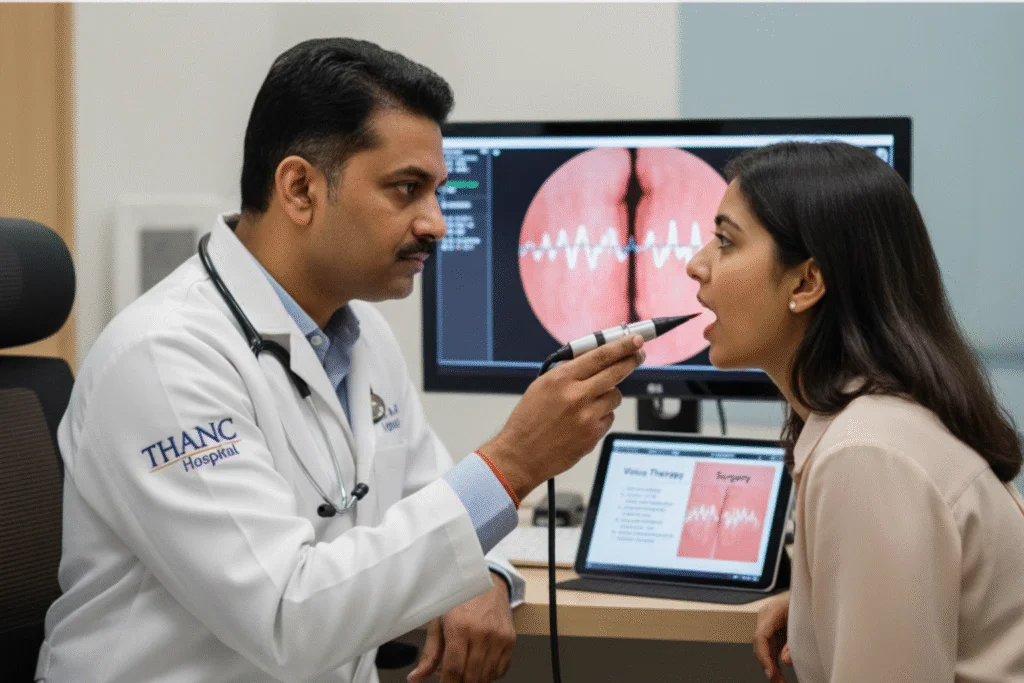
To see your vocal cords in action, the doctor will perform a procedure called laryngoscopy. This is the most important test for diagnosing voice change causes.
- Flexible Laryngoscopy: The doctor sprays a bitter-tasting numbing medication into your nose. They then gently guide a very thin, flexible tube with a high-definition camera through your nasal passage and down to the back of your throat. This allows the doctor to watch your vocal cords open and close as you speak and breathe. The procedure takes less than two minutes and is not painful, though it may feel slightly strange.
- Videostroboscopy: This is a specialized type of laryngoscopy that uses a flashing strobe light. The flashing light creates a slow-motion video effect, allowing the doctor to see the tiny, rapid mucosal waves of your vibrating vocal cords. This test easily reveals small nodules, stiff areas, or subtle nerve weaknesses.
If the doctor sees a suspicious growth or tumor during the scope, they will order imaging tests like a CT scan or MRI of your neck. They will also schedule a biopsy, a procedure where they remove a tiny piece of the tissue to test it for cancer cells.
Treatment Options Based on the Cause
Once your doctor identifies the root cause of your persistent hoarseness, they will create a customized treatment plan. Treatment ranges from simple lifestyle adjustments to advanced surgical procedures.
Voice Therapy
For patients with vocal cord nodules, muscle tension, or mild vocal cord paralysis, voice therapy is the primary treatment. A speech-language pathologist will teach you how to use your voice efficiently without straining your vocal cords. You will learn specific breathing exercises, vocal warm-ups, and techniques to project your voice safely. Voice therapy essentially acts as physical therapy for your throat muscles, helping benign lesions shrink and disappear over time.
Medical Treatment
If a medical condition is driving your voice change, your doctor will prescribe targeted medications.
- For LPR (Silent Reflux): Doctors prescribe antacids or Proton Pump Inhibitors (PPIs) to reduce the amount of acid your stomach produces. This gives your vocal cords the time they need to heal from the chemical burns.
- For Infections: If a bacterial infection causes your laryngitis, the doctor will prescribe antibiotics. However, antibiotics do not cure viral infections.
- For Severe Swelling: In cases of extreme allergic reactions or severe acute laryngitis, doctors may prescribe a short course of oral steroids to rapidly reduce inflammation.
Surgical Intervention
When home care and medical treatments are not enough, surgery becomes necessary.
- Microlaryngeal Surgery: If you have large polyps, stubborn cysts, or suspicious growths, the surgeon will perform phonomicrosurgery. While you are asleep under general anesthesia, the surgeon uses a microscope and specialized, long-handled instruments to delicately remove the growth without damaging the healthy vocal cord tissue. There are no cuts made on the outside of your neck.
- Cancer Treatments: If a biopsy confirms laryngeal cancer, a multidisciplinary team of oncologists and surgeons will manage your care. Treatment may involve radiation therapy, chemotherapy, or surgery to remove part or all of the voice box, depending on the stage of the cancer.
Home Care and First Aid
While you wait for your doctor's appointment, you can take immediate steps at home to protect your vocal cords and encourage healing. Good vocal hygiene forms the foundation of recovery.
What You Can Do Right Now
- Practice Vocal Rest: Stop talking. If you must communicate, use text messages or write on a notepad. Give your vocal cords a complete break to allow the swelling to go down.
- Stay Hydrated: Drink 8 to 10 glasses of room-temperature water every day. Well-hydrated vocal cords vibrate more easily and resist injury better than dry cords.
- Inhale Steam: Boil water, pour it into a bowl, drape a towel over your head, and breathe in the warm, moist air for 10 minutes. Steam provides direct moisture to the vocal cords and helps loosen thick mucus.
What to Avoid
- Do Not Whisper: Whispering actually puts more strain and tension on your vocal cords than speaking in a normal, relaxed tone. If you must speak, use a soft, gentle voice, but do not whisper.
- Stop Clearing Your Throat: Clearing your throat violently slams your vocal cords together. It acts like sandpaper on already irritated tissue. If you feel a tickle or mucus in your throat, take a small sip of water or swallow hard instead.
- Avoid Irritants: Stop smoking immediately and avoid exposure to secondhand smoke. Stay away from dusty environments.
- Modify Your Diet: To prevent acid reflux, avoid spicy curries, fried foods, citrus fruits, caffeine, and alcohol. Eat your dinner at least three hours before you go to sleep, and elevate the head of your bed slightly.
Home care is highly effective for mild, acute laryngitis. However, if you follow these steps for two weeks and your voice does not improve, home care is no longer enough. You must seek professional medical evaluation.
Why See a Specialist at THANC Hospital?
Accurately diagnosing the root cause of voice problems requires specialized equipment and advanced clinical expertise. The Laryngology department at THANC Hospital offers complete care for all voice, airway, and swallowing disorders. Dr. Vidhyadharan S has deep experience in Head & Neck Surgical Oncology and microscopic voice surgery, so every patient receives precise diagnoses and treatments focused on preserving their natural voice. If you are struggling with your voice, do not wait—Book an Appointment today for a thorough evaluation.
Frequently Asked Questions
How long is too long to have a hoarse voice?
If your voice remains hoarse, raspy, or weak for more than two to three weeks, you should see an ENT specialist. While a few days of hoarseness after a cold is normal, persistent changes require a medical examination to rule out serious conditions like nerve damage or cancer.
Can acid reflux really change my voice?
Yes. Stomach acid can travel up your food pipe and spill into your voice box, a condition known as silent reflux. Because your vocal cords are highly sensitive, the acid causes severe swelling and irritation, leading to a chronic raspy voice and a constant need to clear your throat.
Is whispering better for my voice when I am hoarse?
No. Whispering actually forces your vocal cords tightly together and creates more muscle tension than normal speaking. If your voice is hoarse, it is much better to rest your voice completely or speak in a soft, gentle, and relaxed tone.
Does chewing tobacco cause voice box cancer?
Yes. Chewing tobacco products like gutkha or paan masala exposes the tissues in your throat to dangerous, cancer-causing chemicals. Combined with smoking and alcohol consumption, tobacco use is the leading risk factor for developing laryngeal cancer in India.
Will I need surgery if I have vocal cord nodules?
Not usually. Vocal cord nodules are benign growths caused by vocal strain, and they typically respond very well to voice therapy. A speech-language pathologist can teach you how to use your voice correctly, which often allows the nodules to shrink and disappear without any surgical intervention.
How does an ENT doctor look at my vocal cords?
The doctor uses a procedure called flexible laryngoscopy. They will spray a numbing medication into your nose and gently slide a very thin, flexible tube with a camera on the end down the back of your throat. The procedure is quick, painless, and allows the doctor to see your vocal cords clearly on a video monitor.
Learn more about Laryngology
View treatments, doctors & FAQs
Concerned about this condition?
Our specialists can help. Book a consultation today.
Book Consultation
MBBS, MS (ENT), DNB (ENT), MCh (Head & Neck), FICRS, FEB – ORL HNS, ASOHNS
Clinical Director & Senior Consultant Surgeon