
In this article
Non-Surgical vs Surgical Correction — Making the Right Choice
Why this comparison matters A misaligned bite affects much more than just your smile. When your upper and lower teeth do not meet correctly, you experience a condition called malocclusion (a bad bite). An overbite occurs when your upper front teeth overlap your lower front teeth excessively. An underbite happens when your lower jaw protrudes forward, causing your lower teeth to sit in front of your upper teeth.
Research shows that malocclusion affects between 20% and 43% of the population in India. Many people live with these bite issues for years before seeking professional help. However, ignoring a severe bite misalignment can lead to chronic jaw pain, premature tooth wear, and difficulty chewing. It can also contribute to breathing problems like sleep apnea.
Choosing the right treatment path is a major medical decision. If you choose a non-surgical route for a severe skeletal problem, you might experience a relapse where your teeth shift back. If you rush into surgery without exploring non-surgical options, you might undergo an unnecessary procedure. You must understand the mechanics, benefits, and limitations of both approaches to make an informed choice.
Quick overview of each option Non-surgical correction relies entirely on orthodontic tools to move your teeth within the existing bone structure. Orthodontists use braces, aligners, and rubber bands to shift the teeth into a better position. This approach works best when the underlying jaw bones are already well-aligned.
Surgical correction physically changes the size and position of your jaw bones. An oral and maxillofacial surgeon cuts and repositions the bone to create a harmonious facial structure. This approach is necessary when the upper and lower jaws grow at different rates and create a skeletal mismatch.
How Non-Surgical Correction Works
What it involves Non-surgical treatment uses continuous, gentle pressure to move your teeth through the jawbone over time. This process relies on bone remodeling, where the bone breaks down in the direction of the tooth movement and rebuilds behind it. Your doctor will attach brackets to your teeth and connect them with wires to guide this movement.
For a mild overbite, your doctor might use heavy rubber bands attached to your braces. These elastics pull the upper teeth backward and the lower teeth forward. For non-surgical underbite correction, the doctor might use elastics in the opposite direction to pull the lower teeth back.
Modern orthodontics offers several tools for this process:
- Traditional metal braces use stainless steel brackets and wires for precise control.
- Ceramic braces work like metal braces but use tooth-colored brackets for a less noticeable look.
- Clear aligners use a series of custom-made plastic trays to shift teeth gradually.
- Palatal expanders widen the upper jaw in growing children to create more room for crowded teeth.
In some adult cases, doctors use a technique called camouflage orthodontics. This method tips the upper and lower teeth toward each other so they meet correctly, even though the jaw bones remain misaligned. This hides the skeletal issue by fixing the dental alignment.
Who it's best for Non-surgical methods work exceptionally well for growing children and teenagers. Because their jaw bones are still developing, doctors can use specialized appliances to guide the growth of the jaws. This early intervention often prevents the need for surgery later in life.
Adults with mild to moderate dental misalignments also make excellent candidates for non-surgical treatment. If your jaw bones align properly but your teeth simply grew in crooked, braces or aligners can fix the problem completely. Non-surgical treatment also suits patients who cannot take time off work for a surgical recovery.
Advantages and limitations The primary advantage of non-surgical treatment is that it avoids the risks associated with general anesthesia and surgery. You do not have to stay in a hospital, and you will not face a long, painful recovery period. The treatment integrates easily into your daily life, requiring only routine adjustment appointments every few weeks.
However, non-surgical treatment has significant limitations, especially for adults. Once your jaw bones stop growing, braces cannot change their size or shape. If you have a severe skeletal underbite, camouflage orthodontics might improve your bite slightly, but it will not improve your facial profile.
Another limitation is the strict compliance required from the patient. If you use clear aligners, you must wear them for 22 hours a day for them to work. Furthermore, non-surgical correction carries a higher risk of relapse. You must wear retainers every night for the rest of your life to prevent your teeth from shifting back to their original positions.
How Surgical Correction Works
What it involves Surgical correction, formally known as orthognathic surgery (corrective jaw surgery), involves physically repositioning the jaw bones. This process requires a collaborative effort between an orthodontist and an oral surgeon. The entire treatment journey usually takes between 18 and 24 months to complete.
The process begins with pre-surgical orthodontics. You will wear braces for 12 to 18 months to move your teeth into the correct position for your new jaw alignment. During this phase, your bite might actually feel and look worse. This happens because the orthodontist is undoing the natural compensation your teeth made for your misaligned jaws.
Once your teeth are in the right position, you will undergo the surgery in a hospital under general anesthesia. For overbite surgery, the surgeon typically performs a mandibular advancement. They make incisions inside your mouth, cut the lower jaw bone, slide it forward, and secure it with tiny titanium plates and screws. Because the surgeon makes all incisions inside the mouth, you will not have any visible facial scars.
For a surgical underbite correction, the surgeon might perform a mandibular setback to move the lower jaw backward. Alternatively, they might perform a Le Fort I osteotomy to move the upper jaw forward. In severe cases, the surgeon will move both the upper and lower jaws simultaneously to achieve the perfect balance.
After the surgery, you will need a few weeks to recover. Once your jaw bones heal, you will return to your orthodontist for post-surgical orthodontics. You will wear braces for another six months to fine-tune your bite and ensure your teeth lock together perfectly. You can learn more about the different techniques in our guide to corrective jaw surgery.
Who it's best for Surgical correction is best for adults whose jaw bones have completely stopped growing. This usually happens around age 16 for females and ages 18 to 21 for males. Surgery becomes necessary when the size difference between the upper and lower jaws is too large for braces to fix alone.
Patients who suffer from severe functional problems also make ideal candidates for surgery. If your misaligned bite causes chronic jaw joint pain, difficulty chewing, or speech impediments, surgery offers a permanent solution. Additionally, patients with obstructive sleep apnea often benefit greatly from jaw surgery, as moving the jaws forward physically opens the airway.
Finally, surgery is the best option for patients who want to correct facial imbalances. If you have a noticeably receding chin or a protruding lower jaw, surgery will dramatically improve your facial profile. You can read more about how surgery addresses these issues in our article on facial asymmetry.
Advantages and limitations The biggest advantage of surgical correction is its ability to provide a permanent, thorough fix. It addresses the root cause of the problem by aligning the skeletal foundation. This permanently improves your ability to bite, chew, and breathe. It also provides dramatic aesthetic improvements that non-surgical methods simply cannot match.
However, the surgical route requires a significant commitment. You must undergo general anesthesia and spend one or two nights in the hospital. The initial recovery period takes two to three weeks, during which you will experience swelling, bruising, and discomfort. You can find a detailed timeline in our guide to orthognathic surgery recovery.
Another limitation is the strict dietary restriction following the procedure. You must consume a liquid diet for the first few weeks, followed by a soft food diet for another month. You will also experience temporary numbness in your lips and chin due to nerve stretching during the surgery. While this numbness usually resolves within a few months, it can occasionally be permanent.
Key Differences at a Glance
When deciding between non-surgical and surgical routes, comparing the key factors side-by-side helps clarify the commitment required for each.
- Primary Target: Non-surgical treatment moves only the teeth. Surgical treatment moves the actual jaw bones along with the teeth.
- Treatment Timeline: Non-surgical treatment typically takes 1 to 3 years of continuous orthodontic work. Surgical treatment takes 1.5 to 2 years total, but the major structural change happens in a single day during the operation.
- Facial Aesthetics: Non-surgical methods improve the appearance of your smile but do not change your facial profile. Surgical methods dramatically enhance your overall facial balance, profile, and chin projection.
- Recovery Process: Non-surgical adjustments cause mild soreness for a few days after tightening. Surgery requires 2 to 3 weeks of downtime, significant swelling, and a temporary liquid diet.
- Long-Term Durability: Non-surgical camouflage treatments carry a higher risk of the teeth shifting back over time. Surgical bone movements provide a permanent structural foundation that rarely relapses.
- Functional Improvement: Non-surgical methods improve basic chewing. Surgical methods resolve severe chewing difficulties, alleviate chronic jaw joint pain, and can cure obstructive sleep apnea.
Which Option is Right for You?
Choosing the right treatment depends heavily on your unique anatomical situation and personal goals. The first major decision factor is your age. If you are a growing child or teenager, your doctor will almost always recommend non-surgical methods first. By using specialized appliances, doctors can guide your jaw growth and prevent the need for surgery. If you are an adult, your jaw bones have fused, making surgery the only way to fix severe skeletal mismatches.
The severity of your condition also dictates your options. If your overbite or underbite stems purely from crooked teeth, braces or aligners will solve the problem completely. However, if your lower jaw is physically much shorter or longer than your upper jaw, non-surgical methods will only provide a compromised result. You must decide if you want a perfect functional correction or if you are willing to accept a slight compromise to avoid surgery.
Your lifestyle and daily habits play a important role in this decision, especially in India. Traditional Indian diets often feature foods that require heavy chewing, such as tough rotis, raw vegetables, sugarcane, and certain meats. A severe bite misalignment makes chewing these foods difficult, which can lead to poor digestion and nutritional deficiencies. If your bite prevents you from eating a normal diet, the permanent functional fix of surgery often outweighs the temporary inconvenience of the recovery period.
You must also consider your ability to take time away from your daily responsibilities. Overbite surgery requires you to take at least two to three weeks off from work or college. You will also need support from family members during the first week of recovery to help with your liquid diet and medications. If you cannot commit to this downtime, you might need to explore non-surgical camouflage options.
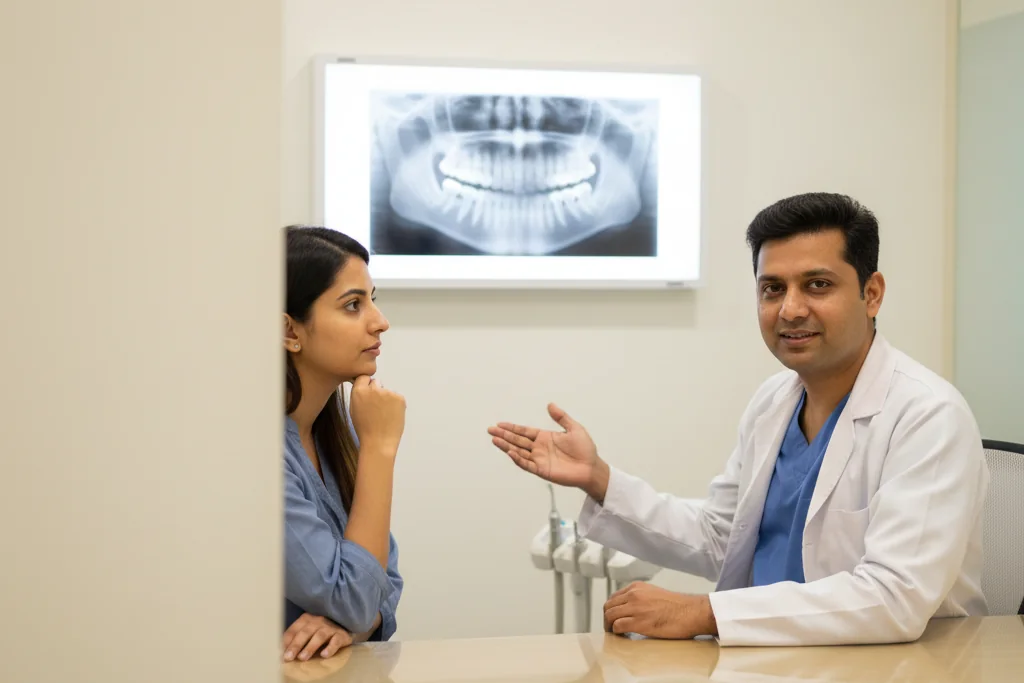
Ultimately, you cannot make this decision alone. Talk to your specialist about your specific symptoms, your aesthetic goals, and your willingness to undergo surgery. A qualified surgeon will use 3D imaging and X-rays to show you exactly what each option can achieve for your specific face.
What We Recommend at THANC Hospital
At THANC Hospital, we believe in a fully patient-centered approach to jaw correction. Dr. M. Veerabahu and our team in the Oral & Maxillofacial Surgery department will never push you toward surgery if a non-surgical option can safely achieve your goals. We conduct a thorough 3D facial analysis to help you understand your unique anatomy, and we work closely with you to choose the treatment plan that best fits your lifestyle and long-term health. If you are ready to explore your options, you can easily Book an Appointment with our specialists.
Frequently Asked Questions
Can an underbite be fixed without surgery in adults?
Yes, mild underbites in adults can sometimes be fixed without surgery using camouflage orthodontics. Your doctor will use braces and elastics to tip your upper teeth forward and your lower teeth backward so they meet correctly. However, this method only moves the teeth and will not change the underlying skeletal protrusion of your lower jaw.
Is overbite surgery painful?
While the idea of jaw surgery sounds painful, most patients report feeling more discomfort and pressure than actual sharp pain. Because the surgeon works around the facial nerves, your jaw and lips will be numb for the first few weeks, which naturally blocks most of the pain. Your surgical team will also provide strong pain management medications to keep you comfortable during the initial healing phase.
How long does it take to recover from jaw surgery?
The initial recovery phase takes about two to three weeks, after which most patients return to work or school. However, your jaw bones need about six weeks to heal enough to handle soft foods, and up to twelve weeks to heal completely. You will continue to see improvements in swelling and facial sensation for up to a year after the procedure.
Will my face look different after underbite correction?
Yes, surgical underbite correction will noticeably change your facial profile. By moving the lower jaw backward or the upper jaw forward, the surgery brings your face into proper proportion. Patients typically experience a more balanced facial appearance, a softer jawline, and a more natural resting lip position.
Do I still need braces if I get jaw surgery?
Yes, braces or clear aligners are a mandatory part of the surgical process. You will wear them for 12 to 18 months before surgery to align your teeth to the new jaw position. After the surgery, you will wear them for another six months to perfect the final bite and ensure your teeth lock together smoothly.
At what age should a child be evaluated for bite issues?
Orthodontic specialists recommend that children receive their first bite evaluation by age seven. At this age, the doctor can identify early signs of jaw growth problems and intervene with non-surgical appliances. Early treatment can guide the jaw bones as they grow, often preventing the need for complex jaw surgery in adulthood.
Learn more about Oral & Maxillofacial Surgery
View treatments, doctors & FAQs
Concerned about this condition?
Our specialists can help. Book a consultation today.
Book Consultation