
In this article
What is a Parotid Tumor?
Your body relies on saliva to keep your mouth moist, help you chew, and begin the process of digesting food. This essential fluid is produced by several glands located in and around your mouth and throat. You have three major pairs of salivary glands: the submandibular glands under your jaw, the sublingual glands under your tongue, and the parotid glands. The parotid glands are the largest of the three. They sit just in front of and slightly below each ear, extending down toward your jawline.
Sometimes, the cells within these glands begin to grow and divide abnormally. When this happens, they form a mass of tissue known as a parotid tumor. This abnormal growth often presents as a noticeable salivary gland swelling on one side of the face. Hearing the word "tumor" can be frightening, but it is important to understand that not all tumors are cancerous. In fact, approximately 80% of all tumors that develop in the parotid gland are benign (non-cancerous).
Benign tumors grow slowly and do not spread to other parts of the body. The most common type of benign growth in this area is a pleomorphic adenoma. Another relatively common benign growth is a Warthin's tumor. While these growths are not cancer, they still require medical attention because they will continue to grow and can press against important nerves in your face. If a tumor is malignant (cancerous), it can invade nearby tissues and spread. The most common type of malignant growth in this gland is called mucoepidermoid carcinoma.
Salivary gland tumors are relatively rare compared to other types of head and neck conditions. They account for roughly 3% to 10% of all head and neck neoplasms. In India, the prevalence of these tumors ranges from 0.4 to 13 cases per 100,000 people every year. They most frequently affect adults between the ages of 40 and 70, though they can occasionally occur in younger individuals. While they are uncommon, recognizing the early signs and seeking prompt medical evaluation can make a significant difference in your treatment outcome.
Causes and Risk Factors
Doctors do not always know the exact cause of a parotid tumor. These growths develop when the DNA inside the gland's cells undergoes mutations. These mutations instruct the cells to multiply rapidly and live longer than normal cells, eventually forming a mass. While the direct cause is often unclear, researchers have identified several risk factors that can increase your chances of developing this condition.
Understanding your risk factors can help you and your doctor make informed decisions about your health. The primary risk factors include:
- Radiation exposure: If you have received radiation therapy to your head or neck in the past, your risk of developing a salivary gland tumor increases. For example, previous radiation treatments for throat cancer can affect the surrounding healthy glands years later.
- Tobacco use: Smoking and chewing tobacco are major health hazards in India. While tobacco is most strongly linked to oral cancers, heavy smoking is specifically associated with the development of Warthin's tumors in the parotid gland.
- Occupational hazards: Exposure to certain industrial and agricultural chemicals can increase your risk. In India, agricultural workers exposed to specific pesticide sprays, as well as industrial workers handling rubber manufacturing chemicals, silica dust, or woodworking dust, face a higher risk over time.
- Age and gender: Your risk increases as you get older. Most of these tumors are diagnosed in older adults. Additionally, certain types of benign tumors, like Warthin's tumors, are more commonly seen in men than in women.
- Diet and nutrition: Some studies suggest that diets low in vitamin C and fiber, but high in cholesterol, may contribute to a higher risk. A traditional Indian diet rich in fresh vegetables and fruits provides protective antioxidants, but shifting toward highly processed foods may alter this balance.
It is important to note that having one or more risk factors does not mean you will definitely develop a tumor. Many people with known risk factors never experience any salivary gland issues. Conversely, some individuals who develop a tumor have no known risk factors at all.

Signs and Symptoms
The symptoms of a parotid tumor depend heavily on the size of the growth and whether it is benign or malignant. Because these tumors often grow very slowly, you might not notice any changes for several months or even years. The most common and earliest sign is a painless salivary gland swelling. You might feel a firm lump just in front of your ear, on your cheek, or right along your jawline.
Many patients first discover this lump accidentally while washing their face, applying makeup, or shaving. In the early stages, the lump usually feels smooth, movable, and completely painless. Just as you would monitor your mouth for early signs of oral cancer, you should always pay attention to any unusual, persistent lumps on your face or neck. As the tumor grows larger, it can begin to press on the surrounding tissues and structures, leading to more noticeable symptoms.
When symptoms progress or if the tumor is malignant, you may experience:
- Persistent pain in your face, cheek, neck, or ear that does not go away.
- A feeling of numbness or tingling in a specific part of your face.
- Difficulty opening your mouth wide to speak or eat.
- Trouble chewing or swallowing, similar to the difficulties experienced by patients requiring tongue cancer surgery.
- Fluid draining from your ear on the affected side.
One of the most critical structures in this area is the facial nerve. This nerve exits your skull and travels directly through the middle of the parotid gland before branching out to control your facial muscles. If a tumor presses against or invades this nerve, you will experience muscle weakness on one side of your face. You might find it difficult to close one eye completely, or you may notice that one corner of your mouth droops when you try to smile.
See a doctor if: You should schedule an immediate consultation with a head and neck specialist if you notice a lump that grows rapidly over a few weeks. You must also seek urgent care if the lump feels rock-hard and fixed in place, or if you experience any sudden facial weakness, numbness, or severe pain. These red flags can indicate a more aggressive condition that requires immediate evaluation.
How is a Parotid Tumor Diagnosed?
If you notice a suspicious lump on your face or jaw, your doctor will guide you through a thorough diagnostic process. The goal is to determine the exact size, location, and nature of the growth. The evaluation begins with a detailed clinical examination. Your doctor will ask about your medical history, your symptoms, and any risk factors you might have.
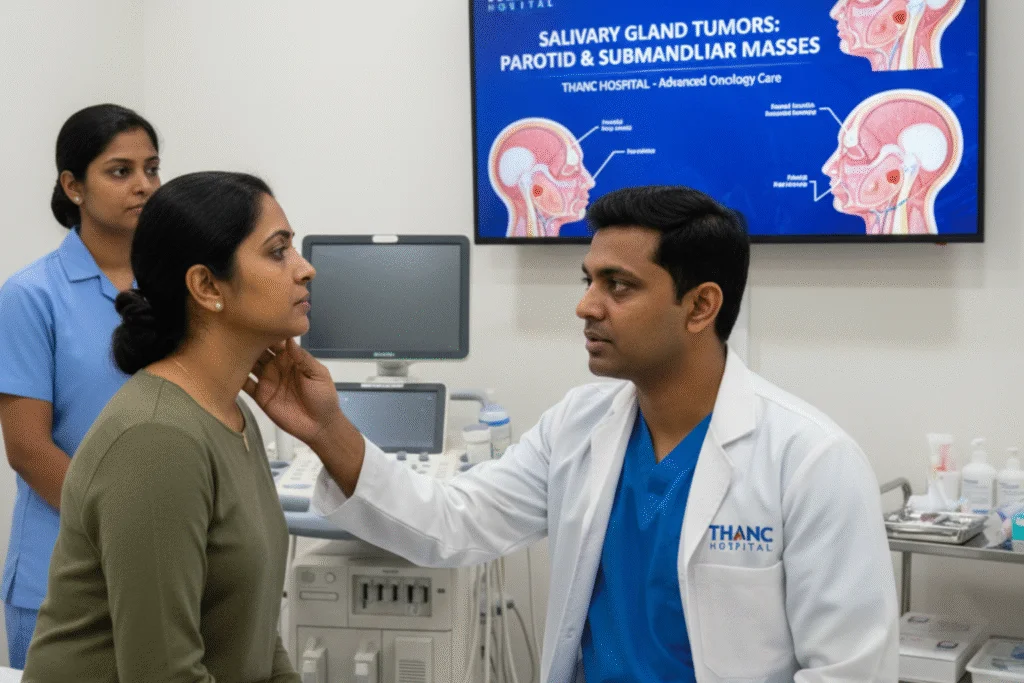
During the physical exam, the doctor will carefully feel your jaw, neck, and the area in front of your ears. They will check the lump to see if it is soft, firm, movable, or attached to deeper tissues. The doctor will also perform a thorough neurological check of your facial nerve. They will ask you to smile broadly, frown, raise your eyebrows, and puff out your cheeks to ensure all branches of the nerve are functioning perfectly.
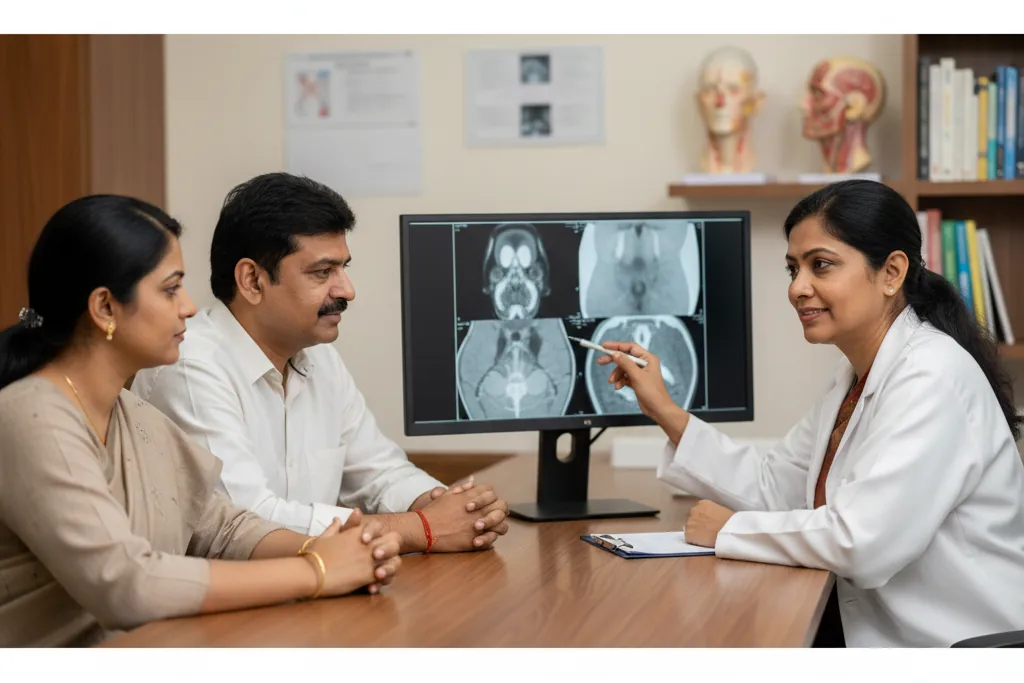
To get a clear picture of the tumor, doctors at THANC Hospital use advanced imaging tests and biopsy procedures:
- Ultrasound: This is usually the first test performed. An ultrasound uses high-frequency sound waves to create images of the inside of your cheek. It is a quick, painless test that helps the doctor see if the lump is a solid mass of tissue or a fluid-filled cyst.
- Magnetic Resonance Imaging (MRI): An MRI is considered the gold standard for evaluating parotid tumors. It uses powerful magnets to provide highly detailed images of your soft tissues. An MRI shows the exact size of the tumor and its precise relationship to the facial nerve and surrounding blood vessels.
- Computed Tomography (CT) scan: A CT scan takes a series of X-ray images from different angles. Your doctor might order this scan to check if a large or aggressive tumor has begun to affect your jawbone or skull base.
- Fine Needle Aspiration Cytology (FNAC): To confirm whether the tumor is benign or malignant, the doctor must examine the cells under a microscope. During an FNAC, the doctor inserts a very thin, hollow needle into the lump to extract a small sample of cells. This procedure feels similar to a routine blood draw and is often guided by ultrasound for accuracy.
- Core Needle Biopsy: If the FNAC does not provide a clear answer, your doctor may perform a core needle biopsy. This uses a slightly larger needle to remove a tiny cylinder of tissue, giving the pathologist more material to study.
You can expect the entire evaluation process to be conducted in a comfortable, outpatient setting. Your medical team will explain every step of the tests and ensure you understand your results. Once the diagnosis is confirmed, your doctor will discuss the best path forward for your specific condition.
Treatment Options
When it comes to treating a parotid tumor, medical management with pills or injections is generally not effective. Because these tumors continue to grow and can eventually damage the facial nerve or turn cancerous, surgery is almost always the primary and most effective treatment. The specific type of surgery you need depends on the size of the tumor, its exact location within the gland, and whether it is benign or malignant.
The surgical removal of the parotid gland is called a parotidectomy. There are two main types of this procedure:
- Superficial Parotidectomy: The facial nerve naturally divides the parotid gland into an outer (superficial) lobe and an inner (deep) lobe. Most tumors grow in the superficial lobe. In this surgery, the doctor removes the tumor along with the outer portion of the gland, carefully leaving the facial nerve intact.
- Total Parotidectomy: If the tumor is located in the deep lobe, is unusually large, or is cancerous, the surgeon must remove the entire parotid gland. This is a more complex procedure because the surgeon must meticulously dissect the gland tissue away from every delicate branch of the facial nerve.
The most critical aspect of any parotid surgery is the preservation of the facial nerve. This nerve controls your ability to express emotion, blink, and eat comfortably. At THANC Hospital, our surgeons use advanced intraoperative nerve monitoring technology. This specialized equipment acts like a radar system during surgery, helping the surgeon identify, track, and protect even the tiniest branches of the facial nerve throughout the operation.
If a tumor is malignant and has already invaded the facial nerve, the surgeon may need to remove a portion of the nerve to clear the cancer. In these rare cases, the surgical team can perform immediate facial nerve reanimation. This advanced reconstructive technique involves using nerve grafts from other parts of your body to repair the connection and restore facial movement over time.
For patients with malignant tumors, surgery might be just the first step. Your doctor may recommend adjuvant therapies to ensure all cancer cells are destroyed. This often involves radiation therapy directed at the surgical site to prevent the tumor from returning. You can learn more about our full surgical approaches by visiting our Head & Neck Surgery department page.
Living with a Parotid Tumor / Recovery and Outlook
Recovering from parotid surgery requires patience and careful attention to your doctor's instructions. Immediately after the operation, you will typically stay in the hospital for two to three days. You will wake up with a bandage over the incision site, which is usually placed discreetly in the natural creases in front of and behind your ear. You will also have a small, temporary drain tube in your neck to remove any excess fluid that builds up under the skin.
During the first few weeks at home, you will need to make some temporary lifestyle modifications. You should eat a soft diet consisting of foods that are easy to chew and swallow. It is also highly recommended to avoid sour, tart, or spicy foods initially. These types of foods strongly stimulate saliva production, which can cause discomfort or swelling in the remaining gland tissue as you heal.
It is very common to experience some temporary facial weakness after surgery. Even when the facial nerve is perfectly preserved, the physical manipulation and stretching during the operation can cause the nerve to "go to sleep" temporarily. You might notice a slight droop in your smile or difficulty closing your eye completely. This weakness usually improves gradually over a few weeks to a few months as the nerve heals. Your doctor may recommend specific facial exercises to help speed up this recovery.
Another potential long-term side effect is a condition known as Frey's syndrome. During the healing process, the tiny nerves that previously controlled saliva production can mistakenly reconnect to the sweat glands in your skin. As a result, you might experience sweating and redness on your cheek while eating. If this becomes bothersome, your doctor can easily treat it with topical antiperspirants or simple injections.
Long-term follow-up care is essential for your continued health. You will need to visit your surgeon for regular check-ups to monitor your healing and ensure the tumor does not return. Your doctor will schedule periodic physical exams and occasional ultrasound scans. By attending all your follow-up appointments and maintaining a healthy lifestyle, you can expect a strong recovery and an excellent long-term outlook.
Why Choose THANC Hospital for Parotid Surgery?
When facing surgery involving delicate facial nerves, choosing a highly specialized team is important for your safety and appearance. At THANC Hospital, Dr. Vidhyadharan S specializes in Head & Neck Surgical Oncology and Microvascular Reconstructive Surgery to every patient. Our surgical team uses continuous intraoperative nerve monitoring to meticulously protect your facial nerve while completely removing the tumor. We focus on delivering precise, safe surgical outcomes while prioritizing your cosmetic appearance and quality of life. If you have noticed an unusual swelling, please Book an Appointment with our specialists today.
Frequently Asked Questions
Is a parotid tumor always cancerous?
No. The vast majority of tumors that develop in the parotid gland are benign, meaning they are not cancerous. Approximately 80% of these growths are benign conditions like pleomorphic adenomas, which grow slowly and do not spread to other parts of the body.
Will I lose my ability to smile after parotid surgery?
Permanent loss of facial movement is very rare when the surgery is performed by an experienced head and neck surgeon. However, it is common to experience temporary facial weakness or an asymmetrical smile for a few weeks after surgery. This happens because the facial nerve is sensitive to being moved during the operation, but it typically recovers fully over time.
How long does it take to recover from parotid surgery?
Most patients can return to their normal daily activities and light work within two to three weeks after the procedure. However, the internal healing process and the complete recovery of any temporary facial nerve weakness can take several months. Your doctor will guide you on when it is safe to resume strenuous exercises.
Can a benign parotid tumor turn into cancer?
Yes, it is possible. While a pleomorphic adenoma is benign, it has a small risk of transforming into a malignant cancer if it is left untreated for many years. This is one of the primary reasons doctors recommend surgically removing these tumors even when they are not currently cancerous.
What foods should I avoid after salivary gland surgery?
For the first few weeks after surgery, you should avoid hard, crunchy foods that require heavy chewing. You must also avoid sour, tart, and highly spicy foods, such as lemons, pickles, and strong curries. These foods stimulate the salivary glands to produce a lot of saliva, which can cause pain and swelling at the surgical site.
Does a parotid tumor cause pain?
In the early stages, most benign parotid tumors are completely painless and only present as a firm lump. If you experience persistent, severe pain, it could indicate that the tumor is growing rapidly, pressing on a nerve, or potentially malignant. You should have any painful facial swelling evaluated by a specialist immediately.
Learn more about Head & Neck Surgery
View treatments, doctors & FAQs
Concerned about this condition?
Our specialists can help. Book a consultation today.
Book Consultation