
In this article

What is Oral Cancer?
Oral cancer refers to any cancerous growth that develops in the tissues of the mouth or the oral cavity. Your oral cavity includes several different parts, and cancer can start in any of them. These areas include your lips, the front two-thirds of your tongue, the upper and lower gums, the inner lining of your cheeks (buccal mucosa), the floor of your mouth under the tongue, the bony roof of your mouth (hard palate), and the small area behind your wisdom teeth.
Most oral cancers begin in the flat, thin cells that line the inside of your mouth. Doctors call these cells squamous cells. When these cells mutate and grow out of control, they form a tumor known as squamous cell carcinoma. This specific type of cancer accounts for more than 90 percent of all oral cancer cases. If left untreated, the cancer cells can invade deeper tissues, spread to the lymph nodes in your neck, and eventually travel to other parts of your body.
Oral cancer is a massive public health challenge in India. According to the GLOBOCAN 2022 statistics, India accounts for nearly one-third of the global oral cancer burden. Doctors diagnose more than 143,000 new cases of mouth and oral cancer in India every year. It ranks as the most common cancer among Indian men and heavily affects younger populations. Unlike Western countries where oral cancer typically affects people in their 60s, Indian hospitals frequently treat patients in their 30s and 40s. This younger age of onset directly links to the widespread use of smokeless tobacco and betel nut products across the country.
Understanding the disease and recognizing the mouth cancer early signs can save your life. When doctors catch oral cancer in its earliest stages, the treatment is less invasive, and the chances of a complete cure are significantly higher.
Causes and Risk Factors
Cancer develops when the genetic material (DNA) inside your cells sustains damage. This damage causes the cells to grow and multiply uncontrollably instead of dying off naturally. While doctors do not always know exactly why a specific person develops cancer, they have identified several major risk factors that drastically increase your chances of developing the disease.
In India, lifestyle habits and cultural practices play a massive role in the high rates of oral cancer. The most significant risk factors include:
- Smokeless Tobacco: Products like gutka, khaini, zarda, and mishri are the leading causes of oral cancer in India. When you hold these products in your mouth, the harmful chemicals sit directly against your gums and inner cheeks. This prolonged contact constantly irritates the tissue and delivers high doses of cancer-causing chemicals (carcinogens) directly into your cells.
- Betel Quid and Areca Nut (Paan and Supari): Many people mistakenly believe that chewing paan without tobacco is safe. However, the areca nut (supari) itself contains powerful carcinogens. Chewing areca nut causes a severe condition called Oral Submucous Fibrosis (OSMF), which makes the inside of the mouth stiff and severely restricts mouth opening. OSMF is a well-known precancerous condition that frequently turns into oral cancer.
- Smoking Tobacco: Smoking cigarettes, beedis, and cigars exposes your mouth, throat, and lungs to intense heat and toxic chemicals. Beedi smoking, which is very common in rural India, carries a exceptionally high risk because beedis lack filters and deliver concentrated smoke directly into the oral cavity.
- Alcohol Consumption: Drinking alcohol irritates the lining of your mouth. Alcohol also acts as a solvent, making it easier for the harmful chemicals in tobacco to penetrate the cells of your mouth. People who both drink alcohol and use tobacco face a multiplied risk of developing oral cancer compared to those who only use one or the other.
- Sharp Teeth and Ill-Fitting Dentures: Constant physical trauma inside the mouth can lead to cancer over time. If you have a broken, sharp tooth or a poorly fitting denture that constantly rubs against your tongue or cheek, it creates a chronic ulcer. If you do not fix the source of the irritation, that non-healing ulcer can eventually turn cancerous.
- Human Papillomavirus (HPV): Certain strains of this common virus, specifically HPV 16 and 18, can cause cancer in the back of the mouth and the throat. HPV-related oral cancers are rising globally and tend to affect younger people who do not smoke or drink.
- Poor Diet: A diet lacking in fresh fruits and vegetables deprives your body of essential vitamins and antioxidants. These nutrients help protect your cells from damage. Nutritional deficiencies can make the lining of your mouth more vulnerable to carcinogens.
Signs and Symptoms
Recognizing the symptoms of oral cancer early is a key step in achieving a successful cure. In its earliest stages, oral cancer often causes no pain at all. Because it does not hurt, many patients ignore the early warning signs or mistake them for a common mouth sore or a minor infection.
You should regularly check your mouth in the mirror while brushing your teeth. The most common mouth cancer early signs include:
- Non-Healing Mouth Ulcers: A common mouth ulcer (canker sore) usually heals completely within 10 to 14 days. If you have a sore, blister, or ulcer in your mouth that does not heal after three weeks, you must have a doctor examine it.
- White or Red Patches: Look for unusual patches on your tongue, gums, or the inside of your cheeks. Doctors call white patches Leukoplakia and red patches Erythroplakia. While not all patches are cancer, they are often precancerous, meaning they can turn into cancer if left untreated. Red patches carry a particularly high risk of becoming malignant.
- Unexplained Bleeding: If your mouth bleeds easily without any obvious cause, such as brushing too hard or a known gum disease, it could indicate an abnormal growth of blood vessels associated with a tumor.
- Rough Spots or Thickenings: You might feel a small lump, a thickened area, or a rough crusty spot inside your mouth with your tongue.
As the tumor grows and invades deeper tissues, the oral cancer symptoms become more noticeable and severe. Advanced symptoms include:
- Difficulty Chewing or Swallowing: You may feel pain when you swallow, or you might feel like food is constantly getting stuck in your throat. Doctors call this symptom dysphagia.
- Restricted Mouth Opening: If a tumor invades the muscles of your jaw, or if you have severe Oral Submucous Fibrosis from chewing betel nut, you may find it difficult to open your mouth fully. Doctors refer to this condition as trismus.
- Numbness: You might experience a loss of sensation or a tingling feeling in your tongue, lower lip, or chin. This happens when the growing tumor presses against or invades the nerves in your face and jaw.
- Ear Pain: The nerves in your mouth and throat share pathways with the nerves in your ears. A tumor in the back of your mouth or the base of your tongue can cause pain that you feel in your ear, even though your ear is perfectly healthy. Doctors call this referred pain.
- Loose Teeth: If cancer invades the jawbone, it can destroy the bone supporting your teeth, causing them to become loose or fall out without any history of severe dental decay.
- A Lump in the Neck: Oral cancer frequently spreads to the lymph nodes in the neck. You might notice a painless, hard lump on the side of your neck that slowly grows larger over time.
See a doctor immediately if you experience any of these symptoms for more than two weeks. Do not wait for the symptom to become painful. Early detection makes a massive difference in your treatment journey.
How is Oral Cancer Diagnosed?
If you visit a doctor with suspected oral cancer symptoms, they will guide you through a systematic diagnostic process. The goal is to confirm whether cancer is present, determine exactly where it is located, and find out if it has spread to other parts of your body.
Clinical Examination
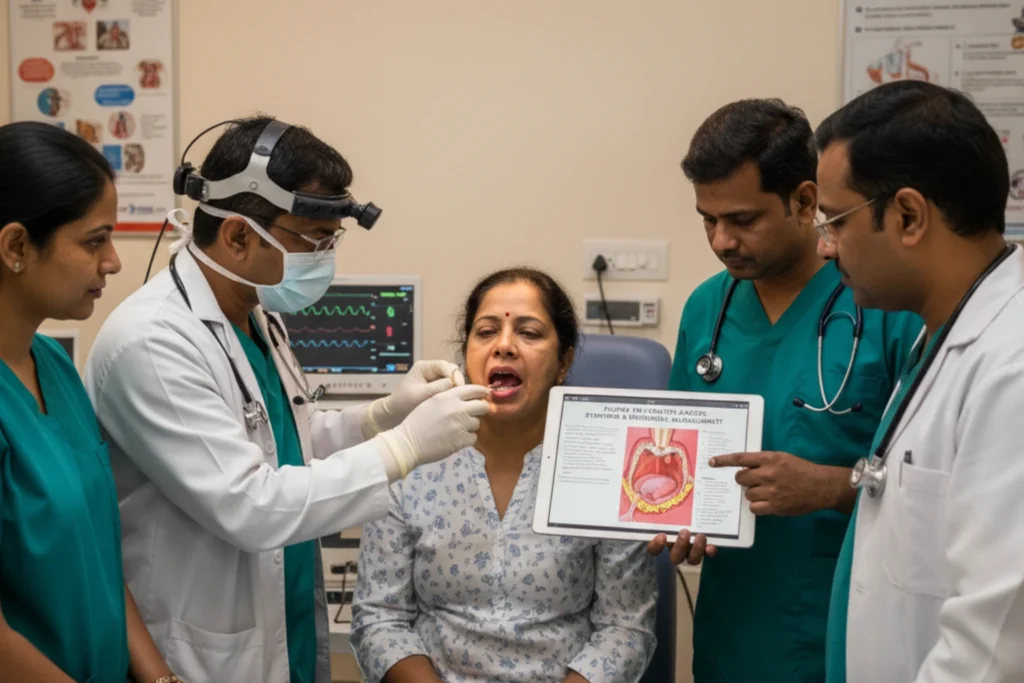
Your evaluation begins with a thorough physical examination. The doctor will ask about your medical history, your lifestyle habits (especially tobacco and alcohol use), and how long you have noticed your symptoms. They will use a bright light and a mirror to carefully examine the inside of your mouth, looking at your lips, cheeks, gums, tongue, and the roof and floor of your mouth. The doctor will also use their gloved fingers to feel the tissues inside your mouth for any hidden lumps or hard areas. Finally, they will feel the outside of your neck to check for enlarged lymph nodes.
Biopsy
A visual exam cannot confirm cancer. The only way to definitively diagnose oral cancer is through a biopsy. During a biopsy, the doctor removes a small sample of tissue from the suspicious area. They send this tissue to a laboratory, where a pathologist examines the cells under a powerful microscope to look for cancer.
- Incisional Biopsy: The doctor numbs the area with a local anesthetic and uses a scalpel to cut a small piece of the tumor.
- Punch Biopsy: The doctor uses a special circular tool to remove a small core of tissue.
- Fine Needle Aspiration Cytology (FNAC): If you have an enlarged lymph node in your neck, the doctor will insert a very thin needle into the lump to draw out cells for testing.
Imaging Tests
Once the biopsy confirms the presence of cancer, your doctor needs to determine the stage of the disease. Staging tells the doctor how large the tumor is and whether it has spread. At THANC Hospital, we use advanced imaging tests to accurately stage the cancer:
- CT Scan (Computed Tomography): A CT scan takes detailed cross-sectional pictures of your head and neck. It helps the doctor see the exact size of the tumor and reveals if the cancer has eaten into your jawbone or facial bones.
- MRI (Magnetic Resonance Imaging): An MRI uses strong magnets and radio waves to create highly detailed images of soft tissues. It is excellent for showing if the cancer has invaded the muscles of your tongue, the nerves in your face, or the soft tissues of your neck.
- PET-CT Scan (Positron Emission Tomography): This full-body scan helps doctors determine if the cancer has spread (metastasized) to distant organs, such as your lungs or liver. It involves injecting a small amount of radioactive sugar into your blood, which highlights rapidly growing cancer cells on the scan.
- Endoscopy: The doctor may pass a thin, flexible tube with a camera down your throat to examine your voice box, windpipe, and food pipe. This leaves no additional tumors are hiding further down your digestive or respiratory tracts.
You can learn more about how we diagnose and treat related conditions by reading our guide on tongue cancer diagnosis, surgery, and recovery.
Treatment Options
Treating oral cancer requires a highly coordinated team approach. At THANC Hospital, our multidisciplinary tumor board—consisting of surgical oncologists, radiation oncologists, medical oncologists, and rehabilitation specialists—reviews every patient's case. Together, they design a treatment plan based on the tumor's size, location, stage, and your overall health.
Surgical Treatment
Surgery is the primary and most effective treatment for the vast majority of oral cancers. The goal of surgery is to completely remove the tumor while preserving as much function and appearance as possible.
- Tumor Resection: The surgeon cuts out the tumor along with a margin of healthy tissue surrounding it. This "clear margin" leaves no microscopic cancer cells remain behind. Depending on where the cancer is located, the surgeon might perform a glossectomy (removing part or all of the tongue), a mandibulectomy (removing part of the lower jawbone), or a maxillectomy (removing part of the upper jaw or roof of the mouth).
- Neck Dissection: Because oral cancer frequently spreads to the lymph nodes in the neck, the surgeon will often perform a neck dissection at the same time as the tumor removal. They carefully remove the lymph nodes and surrounding tissue from one or both sides of your neck to prevent the cancer from spreading further.
- Microvascular Reconstructive Surgery: Removing a large tumor can leave a significant defect in the mouth, affecting your ability to speak, chew, and swallow. To restore your function and appearance, our surgeons perform complex microvascular reconstruction. They take healthy tissue, muscle, or bone from another part of your body—such as your forearm, thigh, or lower leg—and transplant it to your mouth. Using a microscope, the surgeon connects the tiny blood vessels of the transplanted tissue to the blood vessels in your neck, supporting the new tissue survives and heals properly.
Advanced Surgical Techniques
For certain early-stage tumors located in hard-to-reach areas, such as the back of the tongue or the tonsils, THANC Hospital offers minimally invasive options:
- Transoral Robotic Surgery (TORS): The surgeon uses a highly precise robotic system to remove tumors through the mouth without making any external incisions on the face or neck. This approach offers faster recovery times and excellent functional outcomes.
- Transoral Laser Microsurgery (TLM): The surgeon uses a surgical microscope and a precise laser beam to cut out the tumor through the mouth, minimizing damage to surrounding healthy tissues.
Radiation Therapy
Radiation therapy uses high-energy beams, such as X-rays or protons, to kill cancer cells. Doctors may use radiation as the primary treatment for small tumors or for patients who cannot undergo surgery. More commonly, doctors use radiation after surgery (adjuvant radiation) to destroy any microscopic cancer cells that might remain, significantly reducing the risk of the cancer returning.
Chemotherapy
Chemotherapy uses powerful drugs to kill cancer cells throughout the body. Doctors rarely use chemotherapy alone for oral cancer. Instead, they often combine it with radiation therapy (chemoradiation) to make the radiation more effective. Chemotherapy is also used to shrink large tumors before surgery or to control the disease if the cancer has spread to distant organs.
Targeted Therapy and Immunotherapy
For advanced oral cancers, doctors may use newer medications. Targeted therapy drugs specifically attack the unique proteins or genetic mutations found on cancer cells, stopping them from growing. Immunotherapy drugs help your body's own immune system recognize and destroy the cancer cells.
You can explore similar treatment approaches in our detailed article on throat cancer types, stages, and treatment.
Living with Oral Cancer / Recovery and Outlook
Recovering from oral cancer treatment takes time, patience, and dedicated support. The journey does not end when you leave the operating room. Rehabilitation is a important part of your overall treatment plan, so you regain your quality of life.
Immediately after major surgery, you will likely spend some time in the intensive care unit. Because your mouth needs time to heal, you may temporarily receive nutrition through a feeding tube placed into your stomach or through your nose. If the surgery causes swelling in your throat, the surgeon might place a temporary breathing tube in your neck (a tracheostomy) to ensure you can breathe safely. Doctors usually remove these tubes once the swelling goes down and you can swallow safely.
Rehabilitation begins soon after surgery. Our specialized team will work closely with you:
- Speech Therapy: Removing parts of the tongue or jaw changes how you form words. A speech-language pathologist will teach you specific exercises and techniques to improve your articulation and help you speak clearly again.
- Swallowing Therapy (Deglutology): Surgery and radiation can make swallowing difficult or painful. Swallowing therapists will teach you safe swallowing techniques and recommend specific food textures to prevent food from entering your lungs.
- Nutritional Support: Maintaining your weight and nutrition is vital for healing. A clinical dietitian will create a customized meal plan that provides the calories and protein you need, adjusting the consistency of the food as your swallowing improves.
- Physical Therapy: If your surgeon performed a neck dissection or took tissue from your arm or leg for reconstruction, physical therapists will help you regain strength and mobility in those areas.
Long-term follow-up care is absolutely essential. You will need to visit your surgical oncologist regularly for several years. During these visits, the doctor will thoroughly examine your mouth and neck to ensure the cancer has not returned. They will also monitor your overall recovery and manage any late side effects of radiation therapy, such as dry mouth or jaw stiffness.
Making strict lifestyle modifications is the most important thing you can do to protect your health after treatment. You must completely stop using all forms of tobacco and avoid drinking alcohol. Continuing these habits drastically increases the risk of the cancer returning or a new cancer developing.
Why Choose THANC Hospital for Oral Cancer?
When facing a complex disease like oral cancer, the experience of your surgical team directly impacts your outcome. At THANC Hospital, our Head & Neck Surgery department provides care under one roof.
Dr. Vidhyadharan S leads our surgical oncology team. He has deep expertise in Head & Neck Surgical Oncology, Microvascular Reconstructive Surgery, and Transoral Robotic Surgery (TORS). His focus on precise tumor removal combined with advanced reconstructive techniques so that patients not only achieve excellent cancer control but also maintain their ability to speak, swallow, and live a normal life. We guide you through every step of the process, from accurate diagnosis to complex surgery and dedicated rehabilitation.
If you or a loved one are experiencing any concerning symptoms, do not delay your evaluation. Book an Appointment with our specialists today.
Frequently Asked Questions
Is oral cancer curable if caught early?
Yes. When doctors detect oral cancer in its earliest stages (Stage I or II), the disease is highly curable. Early-stage tumors are smaller, easier to remove surgically, and have not spread to the lymph nodes, leading to excellent long-term survival rates.
What are the first signs of oral cancer?
The earliest signs usually include a painless white or red patch inside the mouth, or a mouth ulcer that refuses to heal after two to three weeks. You might also notice unexplained bleeding, a rough spot on your gums, or a small lump in your cheek.
Does chewing paan or supari cause mouth cancer?
Yes. Chewing paan (betel quid) and supari (areca nut) strongly increases your risk of developing mouth cancer, even if you do not add tobacco. The areca nut contains harmful chemicals that damage the lining of the mouth and cause severe precancerous conditions like Oral Submucous Fibrosis.
How do doctors test for oral cancer?
Doctors diagnose oral cancer by performing a physical examination of your mouth and neck, followed by a biopsy. During the biopsy, the doctor removes a small piece of the suspicious tissue and sends it to a laboratory where a pathologist checks it for cancer cells.
Will I be able to speak and eat normally after oral cancer surgery?
Your ability to speak and eat depends on the size and location of the tumor. Surgeons use advanced microvascular reconstructive techniques to rebuild the mouth and restore function. With the help of dedicated speech and swallowing therapists, most patients regain their ability to communicate and eat comfortably.
Is oral cancer surgery painful?
You will not feel any pain during the surgery because you will be under general anesthesia. After the procedure, you will experience some pain and discomfort, but your medical team will provide strong pain relief medications to keep you comfortable while you heal.
Learn more about Head & Neck Cancer Surgery
View treatments, doctors & FAQs
Concerned about this condition?
Our specialists can help. Book a consultation today.
Book Consultation
MBBS, MS (ENT), DNB (ENT), MCh (Head & Neck), FICRS, FEB – ORL HNS, ASOHNS
Clinical Director & Senior Consultant Surgeon