
In this article
- What Is an FUE Hair Transplant and How Does It Work?
- FUE vs. FUT: Understanding the Key Differences
- Assessing Candidacy: Grades of Hair Loss and Donor Availability
- Graft Calculation, Hairline Design, and Density Planning
- What to Expect on the Day of Your FUE Procedure
- Recovery Timeline and Post-Operative Care Guidelines
- FUE Hair Transplant Growth Timeline: From Shedding to Full Density
- Specialized FUE Applications: Beard, Moustache, and Eyebrow Restoration
- Cost of FUE Hair Transplant in Chennai: Key Factors and Pricing Models
- Why Choose THANC Hospital for Hair Restoration in Chennai
- Frequently Asked Questions
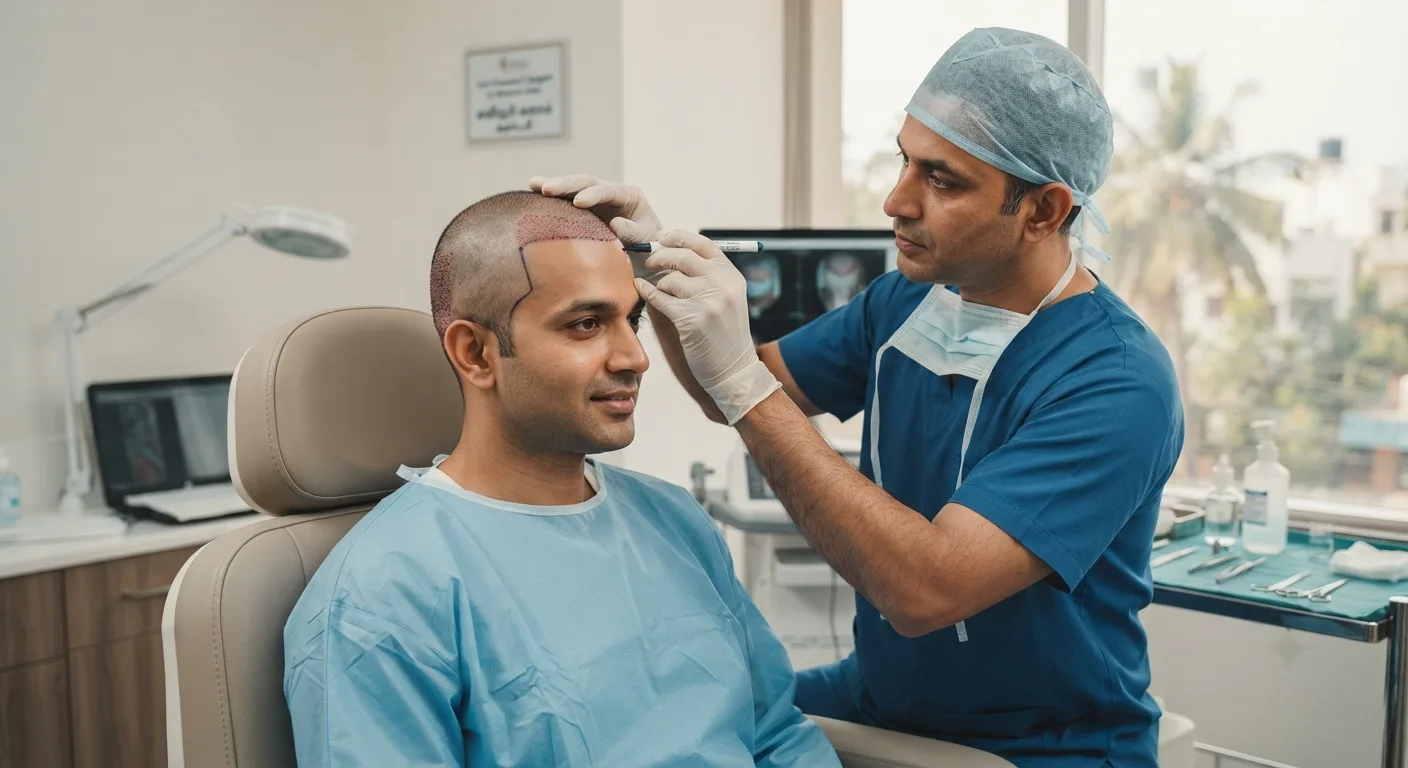
Undergoing a hair restoration procedure is a major aesthetic and medical decision that requires a thorough understanding of surgical techniques, biological viability, and expected outcomes. For individuals considering an FUE hair transplant in Chennai, the city offers sophisticated surgical facilities and specialized facial plastic surgeons capable of delivering permanent, natural-looking follicular density. This guide breaks down the surgical science, candidacy criteria, hairline artistry, recovery stages, and cost considerations to help you make an informed choice.
What Is an FUE Hair Transplant and How Does It Work?
Follicular Unit Extraction (FUE) is an advanced, minimally invasive surgical technique for hair restoration. Unlike legacy procedures that excise continuous sections of tissue, FUE isolates and harvests individual naturally occurring follicular units directly from the patient's scalp. Each follicular unit contains a biological grouping of 1 to 4 terminal hairs, complete with their sebaceous glands, muscles, neurovascular bundles, and surrounding tissue.
The foundational principle enabling successful surgical hair restoration is the biological phenomenon of donor dominance. Hair follicles located in the safe donor zone—the occipital and temporal regions at the back and sides of the head—are embryologically distinct from frontal and vertex hair. These donor follicles lack the high density of androgen receptors that bind to dihydrotestosterone (DHT), the primary hormone responsible for androgenetic alopecia (pattern hair loss). When transplanted to balding areas, these harvested follicles retain their genetic DHT resistance, allowing them to survive, take root, and grow indefinitely throughout the patient's lifetime.
The Science of Micro-Punch Harvesting, Preservation and Implantation Precision
The extraction phase requires extreme surgical precision to prevent mechanical transection (accidental slicing of the hair bulb or shaft). Operating under high-magnification stereomicroscopes or surgical loupes, the surgeon uses specialized circular micro-punches ranging from 0.7 mm to 0.9 mm in diameter. The punch is aligned with the exit angle of the hair shaft, scoring the superficial epidermis and upper dermis just deep enough to loosen the follicle without damaging the underlying dermal papilla.
Once freed, surgical micro-forceps gently elevate the follicular unit from its dermal bed. The harvested grafts are immediately immersed in chilled, physiological holding solutions maintained at 2°C to 4°C. This hypothermic bath minimizes ischemic injury, slows cellular metabolism, and protects cellular viability during the period outside the body.
Implantation precision dictates the final aesthetic result. The surgeon creates recipient sites using ultra-fine sapphire blades or custom needles. These micro-incisions are mapped according to precise parameters:
- Depth: Calibrated precisely to match the biological length of the graft root, preventing cobblestoning (graft elevated above skin) or pitting (graft buried too deep).
- Angulation: Micro-slits in the frontal hairline are created at an acute angle of 15 to 20 degrees relative to the scalp surface, gradually increasing to 30 to 45 degrees over the mid-scalp.
- Direction: Incisions follow the natural radial and whorl flow of hair, ensuring the new hair lays flat and integrates invisibly with native hair.
FUE vs. FUT: Understanding the Key Differences
Surgical hair restoration evolved significantly over past decades. The two primary methods practiced today are Follicular Unit Extraction (FUE) and Follicular Unit Transplantation (FUT, also known as the strip procedure). While both rely on harvesting genetically resistant hair from the safe donor zone, their harvesting mechanics, healing profiles, and patient suitability diverge sharply.
| Comparison Parameter | Follicular Unit Extraction (FUE) | Follicular Unit Transplantation (FUT / Strip) |
|---|---|---|
| Harvesting Method | Individual micro-punch extraction (0.7–0.9 mm) | Surgical excision of a horizontal strip of scalp |
| Scarring Profile | Diffuse, tiny dot micro-scars; practically invisible | Linear horizontal scar across the occipital scalp |
| Post-Operative Pain | Minimal to mild; simple analgesics suffice | Moderate; suture/staple tightness |
| Recovery Window | 5 to 7 days for superficial donor healing | 14 to 21 days; requires suture removal |
| Hairstyle Flexibility | Allows short hair, fades, and buzzed styles | Requires medium to long hair to conceal the scar |
| Donor Morbidity | Low; leaves surrounding vascular beds intact | Higher; involves cutting through deeper tissue |
Scarring and Healing Profile Comparison
The primary clinical advantage of FUE is the absence of a continuous linear scar. In an FUT procedure, the surgeon cuts a full-thickness strip of scalp skin, requiring surgical staples or complex multi-layer closures. Even with advanced closure techniques, horizontal tension can lead to widened linear scars, localized scalp numbness, or chronic tightness in the donor area.
In contrast, FUE generates tiny, circular extraction sites that heal through secondary intention. Within 48 to 72 hours, these micro-wounds form pinpoint crusts and re-epithelialize without sutures. Because the microscopic dot scars are dispersed evenly throughout the donor region, they remain completely hidden within the surrounding hair, even when cut to short clipper grades. This makes FUE the preferred choice for patients who prefer athletic, faded, or closely cropped hairstyles.
FUT is generally reserved for rare cases where an advanced stage of baldness requires 4,000+ grafts in a single session and the patient is unwilling to shave the donor area, or where low donor density makes micro-punch extraction less efficient. For the vast majority of modern patients, FUE provides an ideal balance of minimal tissue trauma, zero linear scarring, and rapid functional recovery.
Assessing Candidacy: Grades of Hair Loss and Donor Availability
Determining whether a patient is an ideal candidate for an FUE hair transplant requires a thorough diagnostic workup. Hair loss is progressive, and surgical intervention must account for both immediate restoration and long-term hair preservation. Patients seeking evaluations through Skin, Hair & Cosmetic Dermatology in Chennai undergo clinical trichoscopy and scalp mapping to establish whether surgical restoration is clinically viable.
Male pattern baldness is graded on the Norwood Classification Scale (Types I to VII), which progresses from a normal mature hairline (Type I) through bitemporal recession and crown thinning to extensive baldness leaving only a narrow horseshoe band of donor hair (Type VII). In female pattern hair loss, surgeons use the Ludwig Scale (Grades I, II, and III), which evaluates diffuse thinning centered along the mid-part line while usually preserving the frontal hairline. Women with localized, stable donor density are excellent candidates, whereas those with diffuse unpatterned alopecia involving the occipital region require medical management rather than surgery.
Critical candidacy requirements include:
- Age & Stability: Ideally 25+ years old with a stabilized hair loss pattern.
- Scalp Health: Free from active scalp infections, psoriasis, or scarring alopecias.
- Donor Density: A minimum of roughly 60 to 70 follicular units per square centimeter.
- Realistic Expectations: Understanding donor limits versus total bald surface area.
Evaluating Donor Hair Density and Caliber
A comprehensive evaluation measures the safe donor area using automated trichoscopy, calculating follicular density (units per square centimeter), hair shaft caliber (coarse, thick hair provides higher optical coverage than fine hair), and follicular unit composition (a high proportion of 3- and 4-hair grafts allows the surgeon to build volume, while 1-hair grafts are reserved for the soft transition zone along the anterior hairline).
Long-term donor management is vital. The human safe donor zone typically yields a lifetime safe maximum of roughly 5,000 to 6,500 harvestable grafts without causing visible donor depletion. A skilled surgeon designs the restoration to preserve a reserve of donor grafts in case the patient requires a secondary procedure decades later as native hair continues to thin.
Graft Calculation, Hairline Design, and Density Planning
A successful hair transplant relies on the fusion of medical science and artistic anatomical design. An unnaturally low, straight, or overly dense hairline creates an artificial appearance that fails as the patient ages. Specialized practitioners within Aesthetic, Plastic & Reconstructive Surgery emphasize natural facial balance and individual aesthetic proportions.
Surgeons calculate the number of grafts needed using surface area metrics (surface area in square centimeters multiplied by target density in grafts per square centimeter):
- Frontal Hairline and Temporal Peaks: approximately 700–1,350 grafts
- Frontal Forelock & Mid-Scalp: approximately 1,200–2,800 grafts
- Vertex / Crown Region: approximately 1,000–2,500 grafts
Hairline Artistry and Natural Micro-Irregularities
The design of the anterior hairline follows classic facial aesthetic landmarks. The central point of the hairline is positioned approximately 7.5 to 8.5 cm above the glabella (the midpoint between the eyebrows), matching the patient's underlying craniofacial proportions. Natural design rules include:
- The Rule of Single Hairs: The first 0.5 to 1.0 cm of the front edge must consist strictly of single-hair follicular units. Multi-hair grafts placed here look "pluggy."
- Micro- and Macro-Irregularities: Natural hairlines are never straight lines. Surgeons construct subtle, deliberate zig-zags set within broader, organic undulations.
- Acute Temporal Angles: The temporal points must frame the lateral borders of the eyes. Failing to recreate them leaves an unnatural, overly open forehead.
What to Expect on the Day of Your FUE Procedure
An FUE procedure is a structured, walk-in, walk-out outpatient surgery that generally takes between 6 and 8 hours, depending on the graft volume.
Anaesthesia and Patient Comfort
Patient comfort is maintained throughout using advanced local tumescent anaesthesia. A customized solution combining lidocaine (for rapid pain blockade), bupivacaine (for sustained relief), and dilute adrenaline (to minimize bleeding) is infiltrated into the donor and recipient zones. A buffered solution and vibration anaesthesia devices make the initial pinpricks virtually painless. Once the regional nerve blocks take effect, the entire scalp remains numb throughout the operation. Patients are conscious and relaxed, able to watch media, listen to audiobooks, or take scheduled breaks.
The Implantation Phase
During the final phase, surgical teams implant the sorted grafts into the pre-cut recipient channels. Using precision micro-forceps or specialized implanters, each graft is inserted without touching the delicate root bulb. The surgical team monitors graft hydration, orientation, and seating level to prevent dehydration or mechanical trauma, ensuring high graft survival rates.
At the conclusion of surgery, the donor region is coated with antibiotic ointment and covered with a sterile dressing, while the recipient area is left exposed or loosely covered with a surgical cap to avoid friction against newly placed grafts. The patient is discharged with a post-operative kit containing oral antibiotics, anti-inflammatory medications, analgesics, and saline spray bottles.
Recovery Timeline and Post-Operative Care Guidelines
The immediate post-operative period is critical for graft survival. During the first few days, the newly placed follicles depend entirely on passive plasma imbibition (absorbing nutrients from surrounding tissue fluids) until micro-vascular revascularization establishes full circulation by day 3 to day 5.
The Crucial First 10 Days of Graft Anchoring
- Sleep Elevation: Sleep at a 30- to 45-degree angle using 2 pillows or a neck pillow for the first 4 nights. This directs lymphatic fluid away from the forehead and eyelids, preventing swelling.
- Hydration Spraying: Mist the recipient area with sterile saline spray every 30 to 60 minutes while awake to keep the grafts hydrated and prevent thick, dry scabbing.
- Zero Friction: Avoid tight hats or shirts with small neck holes. Wear button-down or zippered shirts exclusively.
- Gentle Washing: Do not rub the recipient zone. On day 3, perform the first hair wash by creating foam with diluted mild shampoo, tapping it gently onto the scalp, and rinsing with low-pressure cup pours.
Lifestyle and Activity Restrictions
- Desk work and light walking: from day 2–3.
- Gym workouts and weightlifting: after day 14 (prevents dangerous rises in blood pressure).
- Full-contact sports and swimming: after day 30.
- Motorcycle helmet use: after day 21 (avoids direct shear stress).
- Direct sun exposure: minimize until month 3 to prevent post-inflammatory marks.
Avoiding nicotine and tobacco use is essential for at least 2 weeks before and 4 weeks after surgery. Nicotine is a potent vasoconstrictor that restricts capillary blood flow to the micro-incisions, reducing oxygenation and compromising graft survival.
FUE Hair Transplant Growth Timeline: From Shedding to Full Density
Hair restoration requires patience. Transplanted follicles undergo a predictable biological progression before producing thick terminal hair shafts.
- Month 1 — The "Shock Loss" Phase: Between weeks 2 and 6, 70% to 90% of the transplanted hair shafts will shed. This is completely normal and expected. The mechanical trauma of surgery pushes the hair fibers into the resting phase, but the living dermal papillae remain securely anchored beneath the scalp.
- Months 2 to 3 — The Latent Dormant Phase: The scalp appears largely unchanged. Follicles are reorganizing their cellular matrix, establishing robust capillary connections, and preparing to transition into the growth phase.
- Months 3 to 4 — Early Sprouting: Fine, unpigmented hairs begin emerging from the scalp. Minor folliculitis (small pimple-like bumps) may occasionally appear as new hairs push through; warm compresses easily resolve this.
- Months 6 to 8 — Visible Cosmetic Coverage: Approximately 50% to 60% of transplanted follicles are now producing visible, pigmented hair shafts. Hair caliber thickens, providing the first clear look at your new hairline shape.
- Months 10 to 12 — Peak Density and Integration: Around 80% to 90% of transplanted follicles have reached full maturity. Hair shafts become thicker, darker, and take on your natural hair texture.
- Months 12 to 18 — Final Maturation: Full aesthetic results are reached. The crown region, which has slower circulation than the frontal scalp, completes its final maturation and achieves optimal cosmetic density.
Specialized FUE Applications: Beard, Moustache, and Eyebrow Restoration
While the scalp accounts for the majority of hair restorations, modern FUE micro-punch techniques have evolved to effectively treat facial hair deficiencies—whether resolving genetic patchiness, concealing post-surgical and burn scars, or restoring facial contours.
Beard and Moustache Transplantation
A full, defined beard requires careful management of graft selection and hair exit angles. Surgeons harvest single-hair and double-hair grafts, ideally from the under-chin region if density permits, or from the safe occipital zone. Incisions must be placed flat against the facial planes at acute angles (15 to 30 degrees) pointing downward along the cheeks and jawline, transitioning to dynamic angles along the moustache and chin. This precise orientation prevents hairs from growing straight out, ensuring they lay naturally against the face.
Eyebrow Reconstruction
Eyebrow transplantation is one of the most demanding aesthetic procedures. Follicles are harvested from behind the ear, where hairs are naturally finer and closely match native eyebrow caliber. The head hairs must be placed vertically with a slight lateral tilt; the body hairs must intersect in a delicate herringbone pattern; and the tail hairs must lay almost flush with the skin at an ultra-flat angle of 10 to 15 degrees. Because transplanted scalp hairs retain their donor growth rate, restored eyebrows and facial hair require regular trimming every 10 to 14 days to maintain proper length.
Cost of FUE Hair Transplant in Chennai: Key Factors and Pricing Models
The cost of an FUE hair transplant in Chennai is structured transparently, typically billed on a per-graft basis. In reputable surgical centers across Chennai, prices generally range from ₹30 to ₹60+ per graft, depending on the surgical technique used, the complexity of the case, and the operating surgeon's credentials.
| Stage of Hair Loss | Graft Count Range | Estimated Cost Range (INR) |
|---|---|---|
| Minor (Norwood 2) | 1,000–1,500 grafts | ₹35,000 – ₹80,000 |
| Moderate (Norwood 3–4) | 2,000–2,800 grafts | ₹70,000 – ₹1,50,000 |
| Advanced (Norwood 5–6) | 3,000–4,500 grafts | ₹1,20,000 – ₹2,50,000+ |
| Facial (Beard/Eyebrow) | 500–2,000 grafts | ₹30,000 – ₹1,20,000 |
Costs are indicative estimates and vary with clinical evaluation and hospital infrastructure.
Factors Determining the Total Investment
- Total Number of Grafts: The overall area of baldness directly determines the number of follicular units required to achieve natural-looking density.
- Technological Infrastructure: Utilizing specialized sapphire micro-blades, implanters, hypothermic storage solutions, and microscopic sorting stations influences operating room costs.
- Surgeon Specialization vs. Technician Clinics: Procedures performed entirely by accredited facial plastic and reconstructive surgeons carry premium pricing compared to commercial, unregulated clinics.
- Primary vs. Revision Procedures: Correcting poor outcomes from previous transplants (such as repairing a pluggy hairline or working around depleted donor scar tissue) requires complex surgical planning and higher technical skill.
Patients should be cautious of clinics offering flat-rate or low-cost deals. Low prices often indicate that critical surgical steps—such as punch scoring and recipient site creation—are delegated to unsupervised technicians, raising the risk of high graft transection, poor growth, scalp infections, and unnatural results. In a hospital setting, certified surgeons conduct the surgery within sterile fields with strict emergency protocols and a long-term donor preservation strategy.
Why Choose THANC Hospital for Hair Restoration in Chennai
Selecting the right surgical institution ensures your procedure is backed by medical safety, anatomical expertise, and high-quality aesthetic design. Located centrally in Kilpauk, Chennai, THANC Hospital provides comprehensive care backed by a large clinical team of specialist doctors.
Hair restoration at THANC Hospital is performed by the dedicated Facial Plastic Surgery team of Dr. Vidhyadharan S, Clinical Director at THANC Hospital, with every patient admitted under his care. With hospital expertise spanning complex reconstructive surgery, aesthetic facial surgery, and advanced head and neck cancer surgery, our surgical team brings exceptional anatomical precision to every hair restoration procedure.
Clinical standards at THANC Hospital include:
- Surgeon-Led Precision: Every critical surgical step—from hairline planning and micro-punch donor extraction to recipient site channel creation—is performed directly by experienced surgical specialists.
- Advanced Sterile Suites: Procedures take place within tertiary-care operation theatres with strict infection control and continuous vital-signs monitoring.
- Long-Term Donor Management: We emphasize long-term follicle stewardship, ensuring safe extraction limits that protect native donor hair for the future.
- Comprehensive Care: Every patient receives an individualized medical plan, combining surgical restoration with medical stabilization where appropriate.
Frequently Asked Questions
Is an FUE hair transplant painful?
The procedure is virtually painless. Local tumescent anaesthesia blocks pain sensation across the scalp before extraction and channel creation begin. Patients may feel mild pressure or vibrations during harvesting, but no sharp discomfort. Mild post-operative soreness for 2 to 3 days is well controlled with standard pain relievers.
How long do FUE hair transplant results last?
Transplanted follicles taken from the safe donor zone are genetically resistant to DHT. When transplanted successfully by a skilled surgeon, these follicles retain their genetic resistance and continue growing for a lifetime.
Will I have visible scars after an FUE transplant?
FUE does not leave a linear scar. It creates tiny, circular micro-wounds (under 1.0 mm) that heal as microscopic dot-like marks. These are evenly dispersed across the donor area and remain concealed within surrounding hair, even with short haircuts.
When can I return to work and normal routines?
Most patients resume non-strenuous desk jobs within 2 to 3 days. Visible signs of surgery (light redness and tiny crusts) typically clear within 7 to 10 days. Strenuous workouts, weightlifting, and swimming can safely resume after 14 days.
Can an FUE hair transplant fix an unnatural previous hairline?
Yes. Revision hair restoration is a common application of FUE. Poorly angled or overly large "plug" grafts from prior procedures can be extracted, dissected into single-hair units under microscopic visualization, and re-implanted correctly alongside fresh donor grafts to create a natural, soft hairline.
Learn more about Facial Plastic Surgery
View treatments, doctors & FAQs
Concerned about this condition?
Our specialists can help. Book a consultation today.
Book Consultation
MBBS, MS (ENT), DNB (ENT), MCh (Head & Neck), FICRS, FEB – ORL HNS, ASOHNS
Clinical Director & Senior Consultant Surgeon