
In this article

What is Tongue Cancer?
Tongue cancer is a serious and potentially life-threatening type of oral cancer that begins in the cells of your tongue. To understand this disease, it helps to know that doctors classify most tongue cancers as squamous cell carcinomas. This medical term simply means that the cancer originates in the squamous cells, which are the thin, flat, skin-like cells that line the surface of your tongue and the inside of your mouth. When these cells undergo abnormal genetic changes, they begin to multiply rapidly and form a tumor.
Your tongue is a complex muscular organ divided into two distinct parts, and cancer can develop in either area. The front two-thirds of your tongue is called the oral tongue. This is the part you can see when you open your mouth and stick your tongue out. It plays a vital role in helping you speak clearly, chew your food, and taste different flavors. When cancer develops here, doctors classify it as a type of mouth cancer.
The back one-third of your tongue is called the base of the tongue. This section extends down into your throat and is important for the swallowing mechanism. Because of its location, cancer that develops at the base of the tongue is classified as a type of throat cancer. The location of the tumor significantly impacts the symptoms you experience and the specific tongue tumor treatment you will receive. You can read more about how throat cancers behave in our guide on throat cancer types, stages, and treatment.
In India, oral cancer represents a massive public health crisis. According to the Global Cancer Observatory (GLOBOCAN) data, oral cancer is the most common cancer among men in India and a leading cause of cancer-related deaths nationwide. Every year, medical registries record over 100,000 new cases of oral cancer across the country. Tongue cancer accounts for a very large percentage of these diagnoses.
Historically, this disease primarily affected older men in their sixties and seventies who had a long history of using tobacco and alcohol. However, the demographic is shifting. Today, head and neck surgeons are diagnosing an increasing number of younger patients, including both men and women in their thirties and forties. Catching the disease in its earliest stages greatly improves the chances of successful treatment and long-term survival.
Causes and Risk Factors
Cancer develops when the DNA inside normal cells becomes damaged, causing those cells to grow and divide out of control. While doctors cannot always pinpoint the exact trigger for a single patient, extensive research has identified several major risk factors. These factors expose the cells in your mouth to harmful substances or chronic damage, heavily increasing your chances of developing the disease.
In India, specific cultural practices, dietary habits, and lifestyle choices play a dominant role in the country's high oral cancer rates. The most significant risk factors include:
- Smokeless tobacco use: While smoking cigarettes, bidis, and cigars exposes your mouth to dangerous carcinogens, smokeless tobacco is the leading culprit in India. Chewing products like gutka, khaini, zarda, and mishri involves keeping tobacco against the lining of your mouth and tongue for extended periods. This prolonged contact allows cancer-causing chemicals to deeply penetrate the tissues.
- Areca nut and betel quid: Chewing paan (betel leaf) mixed with areca nut (supari) and slaked lime is a deeply ingrained cultural habit in many parts of India. It is important to understand that areca nut is a proven carcinogen on its own. Even if you chew supari without adding tobacco, you still face a high risk of developing cellular changes that lead to cancer.
- Heavy alcohol consumption: Drinking alcohol regularly acts as an irritant to the delicate squamous cells in your mouth. More importantly, alcohol acts as a solvent. When you combine heavy drinking with tobacco use, the alcohol makes it much easier for the tobacco toxins to enter your cells. This combination multiplies your risk of developing tongue cancer exponentially.
- Human Papillomavirus (HPV): HPV is a very common sexually transmitted virus. While many strains are harmless, certain high-risk strains are a leading cause of cancer at the base of the tongue. HPV-related tumors often develop in the lymphoid tissue at the back of the throat and frequently affect younger patients who do not smoke or drink alcohol.
- Chronic dental trauma: Your mouth is constantly moving. If you have sharp, broken teeth, jagged fillings, or ill-fitting dentures, they can constantly rub against the side of your tongue. Over months and years, this chronic physical irritation forces the cells to constantly repair themselves, which increases the likelihood of a genetic mutation occurring.
- Poor diet and nutritional deficiencies: A diet that lacks fresh fruits and vegetables leaves your body deficient in essential vitamins, minerals, and antioxidants. These nutrients help protect your cells from damage. In India, diets lacking in iron and certain vitamins are linked to a higher risk of oral mucosal diseases.
- Poor oral hygiene: Failing to brush regularly and ignoring gum disease creates a chronic inflammatory environment in your mouth. Chronic inflammation is a known contributor to cancer development.
If you currently use any form of tobacco or chew areca nut, quitting is the single most important step you can take to protect your life. If you require tongue tumor treatment in the future, a history of heavy tobacco use can also complicate your healing process.
Signs and Symptoms
Tongue cancer is notoriously deceptive in its early stages. It often begins as a small, painless change in the appearance or texture of your tongue. Because these early signs do not cause physical discomfort, many patients dismiss them as simple mouth sores or bite marks. However, recognizing these early warnings is critical. Finding the disease early makes tongue cancer surgery much less invasive and dramatically increases your chances of a complete cure.
The symptoms you experience will depend heavily on whether the tumor is located on the oral tongue (the front) or the base of the tongue (the back).
For tumors on the oral tongue, the earliest warning signs you might notice include:
- A persistent white patch (leukoplakia) on the surface or side of your tongue that you cannot scrape off.
- A bright red patch (erythroplakia) that looks raw and velvety. Red patches have a very high risk of turning into cancer.
- A firm, painless lump or thickened nodule on the side of your tongue.
- A sore, ulcer, or crater-like depression that bleeds easily and does not heal after two to three weeks.
You can learn more about identifying these specific tissue changes in our detailed post about oral cancer early signs and symptoms.
As the tumor grows deeper into the muscle of the tongue, the symptoms will progress and become more disruptive. You might experience:
- Increasing pain or a burning sensation when chewing your food or drinking hot liquids.
- Unexplained bleeding from your tongue, even when you are not eating.
- Restricted movement of your tongue, making it difficult to stick your tongue out straight or move it from side to side.
- Changes in your speech, such as developing a lisp or sounding muffled, because your tongue cannot form words properly.
Tumors at the base of the tongue are harder to see and often do not cause symptoms until they grow quite large. If you have a tumor at the base of your tongue, you might notice:
- A persistent feeling that something is caught in the back of your throat.
- Difficulty or pain when swallowing food or pills (dysphagia).
- A change in your voice, often described as a "hot potato" voice.
- Pain in your ear. This happens because the nerves that supply sensation to the back of your tongue also connect to your ear. The brain misinterprets the throat pain as ear pain, a condition known as referred pain.
When the cancer reaches an advanced stage, it frequently spreads to the lymphatic system. At this point, you might discover a hard, painless lump in your neck. This indicates that the cancer has traveled to your neck lymph nodes. You might also experience unexplained weight loss and severe fatigue.
See a doctor if... You should book an appointment with a head and neck specialist immediately if you notice any mouth sore, lump, red patch, or white patch that lasts longer than three weeks. Do not wait for the area to become painful. A painless, non-healing mouth ulcer is one of the most classic and urgent warning signs of oral cancer.
How is Tongue Cancer Diagnosed?
If you visit a doctor with symptoms suggesting tongue cancer, they will guide you through a thorough diagnostic evaluation. The primary goals of this process are to confirm whether cancer cells are present, determine the exact size and depth of the tumor, and check if the disease has spread to other parts of your body. This staging process is absolutely essential, as it dictates every step of your tongue tumor treatment plan.
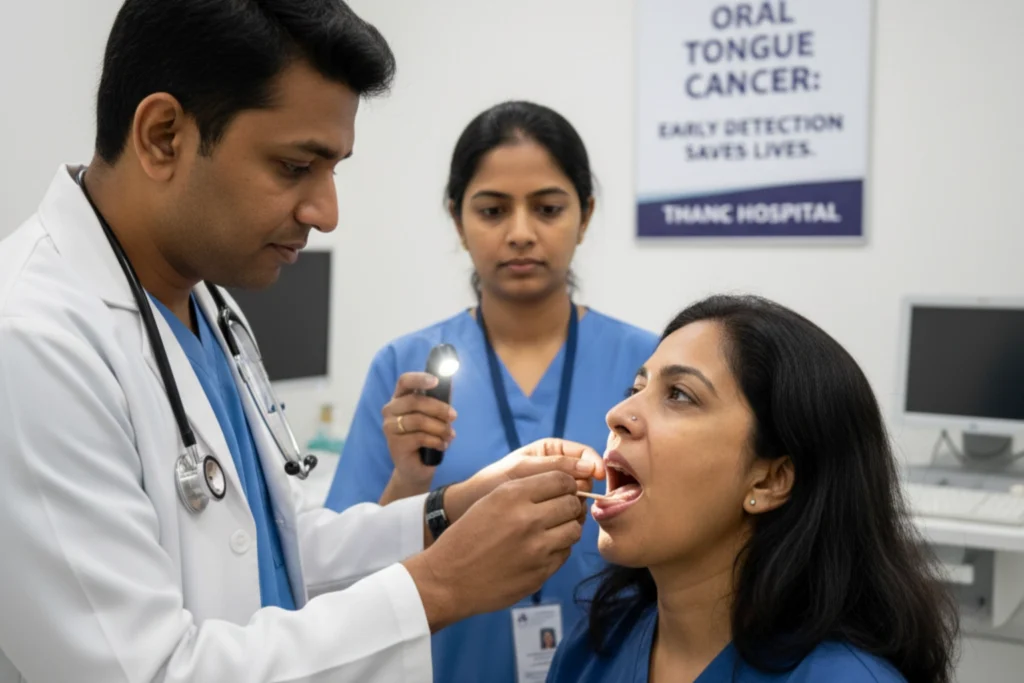
The evaluation always begins with a detailed clinical examination. Your doctor will ask you about your medical history, your symptoms, and any habits like tobacco or alcohol use. Next, they will perform a physical exam of your head and neck. Using a bright light and a small mirror, they will visually inspect every area of your mouth. They will use their gloved fingers to feel your tongue, the floor of your mouth, and your cheeks. Feeling the tumor helps the doctor understand how deep it extends into the muscle. The doctor will also carefully feel both sides of your neck to check for enlarged or hardened lymph nodes.
If the doctor suspects a tumor is located at the base of your tongue, they will perform a procedure called an endoscopy or laryngoscopy. They will gently insert a thin, flexible tube equipped with a light and a high-definition camera (endoscope) through your nose and down into your throat. This allows them to clearly see the back of your tongue and your vocal cords on a video monitor.
If the doctor finds a suspicious lesion, the next mandatory step is a biopsy. A biopsy is a minor procedure where the doctor removes a small sample of tissue from the tumor. A specialized doctor called a pathologist then examines this tissue under a microscope to look for cancerous cells. A biopsy is the only medical way to definitively diagnose cancer.
Depending on the tumor's location, your doctor might perform:
- Punch biopsy: The doctor uses a small, circular tool to remove a core of tissue from the tumor.
- Incisional biopsy: The doctor uses a scalpel to cut a small piece of tissue from the edge of the tumor.
- Fine Needle Aspiration Cytology (FNAC): If you have a lump in your neck, the doctor will insert a very thin needle into the lymph node to extract cells for testing.
Doctors perform oral biopsies using local anesthesia. They will inject a numbing medication into the area, similar to what a dentist uses, so you will not feel sharp pain during the procedure.
Once the pathologist confirms the presence of cancer, you will need advanced imaging tests to complete the staging process. At THANC Hospital, we use precise imaging technology to map the disease. Your doctor will likely recommend:
- Magnetic Resonance Imaging (MRI): An MRI uses powerful magnets and radio waves to create highly detailed images of the soft tissues in your mouth and neck. It is the best test for showing exactly how deep the tumor has invaded the tongue muscle and whether it has reached nearby nerves or blood vessels.
- Computed Tomography (CT) scan: A CT scan takes rapid, cross-sectional X-rays of your head and neck. Doctors use CT scans to check if the cancer has eroded into your jawbone and to get a clear view of the lymph nodes in your neck.
- PET-CT scan: For advanced tumors, doctors use a full-body PET-CT scan. They will inject a small amount of safe, radioactive sugar into your vein. Because cancer cells consume sugar faster than normal cells, they light up on the scan. This helps doctors verify if the cancer has spread to distant organs, such as your lungs or liver.
Treatment Options
Treating tongue cancer is a complex process that requires a highly coordinated, team-based approach. Your care team will include head and neck surgeons, reconstructive surgeons, radiation oncologists, medical oncologists, and specialized rehabilitation therapists. Together, they will review your biopsy results and imaging scans in a tumor board meeting to design a personalized tongue tumor treatment plan.
For the vast majority of patients, tongue cancer surgery is the primary and most effective treatment. The surgical goal is twofold: to completely remove all cancer cells from your body, and to preserve as much of your ability to speak, chew, and swallow as possible. The specific type of surgery you undergo depends entirely on the size and location of the tumor.
The surgical options for removing the tumor include:
- Partial glossectomy: If you have a small, early-stage tumor, the surgeon will remove the cancer along with a small margin of healthy tissue surrounding it. This margin leaves no microscopic cancer cells are left behind.
- Hemiglossectomy: For larger tumors that affect one side of the tongue, the surgeon must remove that entire half of the tongue.
- Total glossectomy: In rare cases where a massive tumor involves the entire tongue, the surgeon must perform a total removal to save the patient's life.
- Neck dissection: Because tongue cancer aggressively spreads to the lymph nodes in the neck, your surgeon will almost always perform a neck dissection during the same operation. They will carefully remove the lymph nodes and surrounding fat from one or both sides of your neck to prevent the cancer from spreading further.
When a surgeon removes a significant portion of your tongue, they must rebuild the area to restore your oral function. This highly specialized procedure is called microvascular reconstructive surgery. During this phase of the operation, a reconstructive surgeon takes healthy tissue—including skin, muscle, and blood vessels—from another part of your body. Common donor sites include your forearm, your outer thigh, or your lower leg bone if your jaw is also affected.
The surgeon shapes this donor tissue to replace the missing part of your tongue. Then, using a high-powered microscope and sutures thinner than a human hair, they painstakingly connect the tiny blood vessels of the new tissue to the blood vessels in your neck. This restores blood flow, allowing the new tissue to live and function in your mouth.
At THANC Hospital, we also offer minimally invasive surgical techniques for specific cases, particularly tumors located at the base of the tongue. Transoral Robotic Surgery (TORS) and Transoral Laser Microsurgery (TLM) allow our surgeons to access and remove tumors through your open mouth, without making large incisions across your neck or splitting your jawbone. The robotic arms provide a 3D, high-definition view and can maneuver in tight spaces that human hands cannot reach. These advanced techniques often result in faster recovery times, less pain, and better swallowing function.
Following surgery, many patients require additional treatments to destroy any microscopic cancer cells that might remain and to reduce the risk of the cancer returning. This is known as adjuvant therapy.
- Radiation therapy: This treatment uses precisely targeted, high-energy X-ray beams to kill cancer cells. Doctors frequently recommend radiation after surgery if the tumor was very large, if the surgical margins were close, or if cancer was found in your lymph nodes.
- Chemotherapy: This involves using powerful intravenous drugs to circulate throughout your body and destroy cancer cells. Doctors often combine chemotherapy with radiation therapy to make the radiation more effective.
- Targeted therapy and Immunotherapy: These are newer classes of medications. Targeted therapy attacks specific proteins that cancer cells use to grow. Immunotherapy boosts your body's own immune system, helping it recognize and destroy cancer cells. Doctors typically use these drugs for advanced cancers that cannot be treated with surgery alone.
Living with Tongue Cancer / Recovery and Outlook
Recovering from tongue cancer surgery is a journey that requires time, resilience, and dedicated support. Your specific recovery experience will depend heavily on the size of the tumor removed and the complexity of your reconstructive surgery. Your medical team will monitor you closely and support you through every phase of healing.
Immediately following a major surgery, you will spend a few days in the intensive care unit (ICU). The nursing staff will closely monitor your vital signs and check the blood flow to your reconstructed tongue flap every hour. Because your mouth and throat will be significantly swollen, you will likely wake up with a temporary breathing tube placed directly into your windpipe through a small hole in your neck. This is called a tracheostomy, and it gives you can breathe safely while the swelling subsides.
You will also have a feeding tube placed either through your nose into your stomach or directly through your abdomen. This tube provides you with essential liquid nutrition and medications while your mouth heals and you are unable to swallow safely. As the swelling decreases over the first week or two, your doctors will remove the tracheostomy tube, allowing you to breathe normally through your nose and mouth again.
Once the initial healing is underway, you will begin the most critical phase of your recovery: rehabilitation. You will work extensively with a speech and swallow therapist. Because your reconstructed tongue will feel different and lack normal muscle movement, you must relearn how to perform basic functions. The therapist will guide you through daily exercises to strengthen your remaining tongue muscles, improve your articulation for clearer speech, and train your throat muscles to swallow safely without food entering your lungs. You will slowly transition from tube feeding to a liquid diet, then to soft foods, and eventually back to a modified normal diet.
Living with the aftermath of oral cancer requires permanent lifestyle modifications to protect your health. To prevent the cancer from returning, you must absolutely cease all use of tobacco and areca nut products. You must also avoid drinking alcohol. Adopting a balanced diet rich in vegetables and maintaining meticulous oral hygiene will help keep your mouth tissues healthy.
Follow-up care is a lifelong commitment. You will need to visit your head and neck surgeon frequently during the first two years after treatment, usually every few months. During these visits, the doctor will thoroughly examine your mouth and neck, and they will order periodic imaging scans. These routine check-ups are vital because they help catch any signs of the cancer returning at the earliest possible stage, when it is most treatable.
Why Choose THANC Hospital for Tongue Cancer?
At THANC Hospital, our Head & Neck Surgery department provides multidisciplinary care tailored to your specific diagnosis. Our surgical team is led by Dr. Vidhyadharan S, who specializes in Head & Neck Surgical Oncology, complex tongue cancer surgery, and minimally invasive techniques like Transoral Robotic Surgery (TORS). We are dedicated to guiding you through every step of your treatment and rehabilitation; please Book an Appointment to consult with our specialists.
Frequently Asked Questions
Is tongue cancer completely curable if caught early?
Yes, tongue cancer is highly curable when doctors detect and treat it in its earliest stages. Small tumors that have not spread to the lymph nodes have an excellent long-term survival rate. Even in more advanced stages, a full treatment plan combining surgery, radiation, and chemotherapy can successfully cure the disease.
How long does it take to recover from tongue surgery?
Your recovery time depends entirely on the extent of the surgery performed. For a minor procedure to remove a small tumor, you might recover and return to normal activities in two to three weeks. For a major surgery involving microvascular reconstruction, you can expect to spend one to two weeks in the hospital and several months participating in speech and swallowing rehabilitation.
Will I be able to speak normally after my tongue is removed?
Your ability to speak will depend on how much of your tongue the surgeon must remove and how it is reconstructed. Most patients experience some changes in their speech, especially when pronouncing certain consonants. However, working closely with a speech therapist helps the vast majority of patients learn to communicate clearly and effectively after they heal.
Can I get tongue cancer if I have never smoked or chewed tobacco?
Yes, you can develop this disease even if you have never used tobacco products. Other significant risk factors include heavy alcohol consumption, chronic irritation from sharp teeth, and poor oral hygiene. Additionally, the Human Papillomavirus (HPV) is a leading cause of cancer at the base of the tongue, particularly in younger people who do not smoke.
Is a biopsy for the tongue painful?
Doctors use local anesthesia to completely numb the area before performing a biopsy, so you will not feel sharp pain during the procedure. You might feel some mild pressure while the doctor removes the small tissue sample. After the numbing medication wears off, you may experience minor soreness for a few days, which you can easily manage with simple pain relievers.
What foods should I avoid to prevent oral cancer?
To lower your risk of developing oral cancer, you should completely avoid chewing areca nut (supari) and paan, as these are highly linked to the disease in India. You should also limit your intake of highly processed foods and avoid heavy alcohol consumption. Instead, focus on eating a balanced diet rich in fresh fruits, vegetables, and essential vitamins to maintain healthy mouth tissues.
Learn more about Head & Neck Cancer Surgery
View treatments, doctors & FAQs
Concerned about this condition?
Our specialists can help. Book a consultation today.
Book Consultation
MBBS, MS (ENT), DNB (ENT), MCh (Head & Neck), FICRS, FEB – ORL HNS, ASOHNS
Clinical Director & Senior Consultant Surgeon