
In this article
Jaw Lock — What Could It Mean?
Waking up to find your jaw locked shut is a terrifying and stressful experience. You might feel a sudden, sharp pain when you try to speak, or you may simply find that your jaw refuses to move past a certain point. When you cannot open your mouth normally, everyday activities like eating, talking, and even yawning become incredibly difficult.
The medical term for a restricted mouth opening is trismus. This condition occurs when the complex system of muscles, bones, and joints that control your jaw stops functioning correctly. Your jaw relies on the temporomandibular joint (TMJ), which acts like a sliding hinge connecting your lower jawbone to your skull. A network of powerful chewing muscles surrounds this joint to guide its movement.
When one part of this system fails, your body often triggers a protective reflex. The muscles tighten up to prevent further damage, leaving your jaw stuck in place. While this symptom feels like an immediate crisis, you should know that most causes of a locked jaw are highly treatable.
The underlying issue could range from a simple muscle cramp to a displaced joint disc or a severe dental infection. In some cases, the restriction happens suddenly overnight. In other situations, the stiffness develops gradually over several months until you finally realize you cannot open your mouth wide enough to take a normal bite of food. Understanding the root cause is the first step toward finding relief and restoring your normal jaw function.
Common Causes of Jaw Lock
A locked jaw rarely happens without a reason. Medical professionals categorize the causes based on whether the issue originates in the joint, the muscles, an infection, or a chronic lifestyle habit.
Temporomandibular Joint (TMJ) Disorders
TMJ disorders are the most frequent culprits behind a suddenly locked jaw. The joint contains a small, shock-absorbing cartilage disc that allows your jaw to open and close smoothly.
- Disc Displacement: Sometimes, this cartilage disc slips out of its normal position. If the disc moves too far forward, it acts like a physical doorstop inside the joint, preventing the jaw from opening.
- Arthritis: Wear and tear on the joint over time can damage the bone and cartilage, leading to severe stiffness and pain.
- Bruxism: Grinding or clenching your teeth at night puts immense pressure on the TMJ, which can eventually cause the joint to seize up.
Muscle Spasms and Myofascial Pain
Your chewing muscles, particularly the masseter muscle in your cheek, are incredibly strong. When these muscles become overworked or injured, they can go into a severe spasm.
- Stress and Anxiety: High stress levels often cause people to unconsciously clench their jaw muscles throughout the day.
- Overexertion: Chewing very hard or sticky foods, or keeping your mouth open for a long dental procedure, can exhaust the muscles and trigger a spasm.
Dental and Facial Infections
Infections in the mouth can easily spread to the muscles and tissues that control jaw movement.
- Pericoronitis: This is an infection of the gum tissue surrounding a partially erupted wisdom tooth. It is a very common cause of trismus in young adults.
- Dental Abscess: A severe infection at the root of a decayed tooth creates a pocket of pus. The body responds with intense swelling, which physically blocks the jaw from moving.
Oral Submucous Fibrosis (OSMF)
In India, a highly prevalent cause of restricted mouth opening is Oral Submucous Fibrosis (OSMF). Research indicates that the prevalence of OSMF in India is around 6.4%.
- This chronic condition is strongly linked to the habit of chewing gutkha, pan masala, betel quid, and areca nut.
- Over time, the soft, flexible tissues inside the cheeks and lips become replaced by rigid, rope-like fibrous bands.
- Patients often experience a burning sensation when eating spicy food, followed by a gradual decrease in mouth opening. OSMF requires specialized medical intervention and the immediate stopping of all tobacco and areca nut habits.
Trauma and Injury
Physical impact to the face can disrupt the mechanics of the jaw.
- Fractures: A break in the lower jawbone or the cheekbone can physically prevent the mouth from opening.
- Dislocation: If you yawn too widely or sustain a blow to the chin, the jaw joint can pop completely out of its socket. In this case, the jaw usually gets locked in an open position rather than closed.
Rare but Serious Causes
- Tetanus: Often called "lockjaw," this is a severe bacterial infection usually contracted through a puncture wound from a rusty object. The bacteria release a toxin that causes severe muscle stiffness starting in the jaw.
- Radiation Therapy: Patients who have undergone radiation treatment for head and neck cancers may develop tissue scarring that restricts jaw movement.
When to See a Doctor
While a stiff jaw can sometimes resolve on its own with rest, a completely locked jaw requires professional evaluation. You need to know how to distinguish between a situation that can wait a few days and a true medical emergency.
Go to the Emergency Room Immediately If:
- You experience any difficulty breathing or swallowing.
- You have a high fever accompanied by severe facial swelling, which indicates a spreading infection.
- Your jaw is locked wide open, and you cannot close it.
- The jaw lock occurred immediately after a physical injury, fall, or accident.
- You recently suffered a puncture wound or deep cut and are now experiencing jaw stiffness (potential tetanus risk).
Schedule an Appointment Within a Few Days If:
- You feel sharp pain in front of your ear when you try to force your mouth open.
- You hear loud clicking, popping, or grating sounds from your jaw joint.
- You notice a gradual decrease in how wide you can open your mouth over several weeks or months.
- You have a history of chewing gutkha or betel nut and feel rigid bands forming inside your cheeks.
- Your jaw feels stiff every morning when you wake up but loosens slightly throughout the day.
Ignoring a restricted mouth opening can lead to severe complications. If an infection is left untreated, it can spread to your neck or bloodstream. If a displaced joint disc is ignored, it can cause permanent damage to the joint cartilage.
What to Expect at Your Appointment
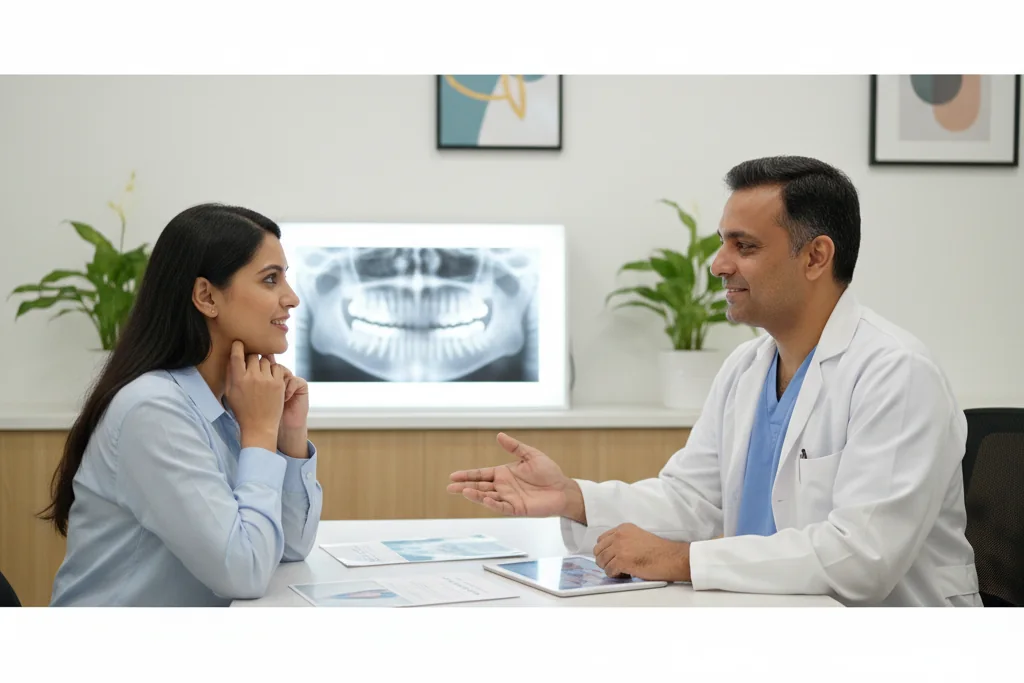
When you visit an Oral & Maxillofacial Surgery specialist, the primary goal is to identify the exact reason why you cannot open your mouth. The doctor will conduct a thorough investigation to pinpoint the problem.
The Medical Interview
Your doctor will start by asking detailed questions about your symptoms and lifestyle. They will ask when the locking started and whether it happened suddenly or gradually. You will need to discuss your dietary habits, including whether you chew tobacco, gutkha, or areca nut. The doctor will also ask if you grind your teeth at night, if you have experienced recent high stress, or if you recently had extensive dental work done.
The Physical Examination
The specialist will gently examine your face, jaw, and neck.
- Measuring Mouth Opening: The doctor will measure the distance between your upper and lower front teeth. A normal mouth opening is typically between 35 to 50 millimeters, or roughly the width of three fingers.
- Muscle Palpation: The doctor will press on the chewing muscles in your cheeks and temples to check for painful knots or spasms.
- Joint Assessment: They will place their fingers just in front of your ears and ask you to open and close your mouth as much as possible to feel for joint movement and listen for clicking sounds.
- Intraoral Exam: The doctor will look inside your mouth for decayed teeth, infected wisdom teeth, or the rigid fibrous bands associated with OSMF.
Diagnostic Imaging and Tests
To see what is happening beneath the skin, your doctor will likely order imaging tests.
- OPG (Panoramic X-ray): This broad X-ray shows your entire upper and lower jaw, revealing bone fractures, severe tooth decay, and impacted wisdom teeth.
- CBCT Scan: A specialized 3D scan that provides a highly detailed view of the jawbones and the bony structures of the TMJ.
- MRI (Magnetic Resonance Imaging): If the doctor suspects a displaced cartilage disc, an MRI is the best way to visualize the soft tissues inside the joint.
Treatment Options Based on the Cause
Once your doctor determines why your jaw locked shut, they will create a targeted treatment plan. Treatments range from simple medications to advanced surgical procedures, depending entirely on the root cause.
Treatments for TMJ Disorders and Muscle Spasms
If your jaw is locked due to a muscle spasm or a displaced joint disc, the focus is on relaxing the muscles and reducing inflammation.
- Medications: Your doctor may prescribe muscle relaxants to stop the spasms and non-steroidal anti-inflammatory drugs (NSAIDs) to reduce pain and swelling.
- Bite Splints: If you grind your teeth, a custom-made acrylic mouth guard worn at night will protect your joint from further pressure.
- Arthrocentesis: For a stuck joint disc, the surgeon may perform a minimally invasive procedure called arthrocentesis. They flush the joint with sterile fluid to wash out inflammatory chemicals and inject a lubricating medication to help the disc slide back into place.
Treatments for Dental Infections
If an infection is blocking your jaw movement, eliminating the bacteria is the top priority.
- Antibiotics: A strong course of antibiotics will help clear the infection and reduce the swelling.
- Abscess Drainage: If there is a pocket of pus, the surgeon will make a small incision to drain it, which often provides immediate relief from the jaw stiffness.
- Tooth Extraction: If an impacted wisdom tooth is causing the infection, the surgeon will safely remove the tooth once the initial swelling goes down.
Treatments for Oral Submucous Fibrosis (OSMF)
Treating OSMF requires a strict and dedicated approach, as the fibrous bands do not disappear on their own.
- Habit Cessation: You must completely stop chewing gutkha, pan masala, and areca nut immediately.
- Medical Therapy: Doctors often use intralesional injections of corticosteroids and enzymes directly into the fibrous bands to reduce inflammation and break down the scar tissue.
- Physiotherapy: Regular, guided mouth-opening exercises are important to stretch the tissues and regain movement.
- Surgical Release: In severe cases where the mouth opening is extremely restricted, an oral surgeon may need to surgically cut the fibrous bands and reconstruct the inner cheek lining.
Treatments for Jaw Trauma and Structural Issues
If your jaw is locked due to an injury or severe skeletal misalignment, surgical intervention is usually necessary.
- Manual Reduction: If your jaw is dislocated and stuck open, a doctor will use specific manual techniques to guide the joint back into its socket. Never attempt to force a dislocated jaw back into place yourself.
- Fracture Repair: Broken jawbones require surgical plating and wiring to heal correctly.
- Corrective Jaw Surgery: For patients with severe bite misalignments that cause chronic joint locking, orthognathic surgery may be required. You can learn more about this process in our guide to Corrective Jaw Surgery and what to expect during Orthognathic Surgery Recovery. Proper alignment is also important for Underbite & Overbite Correction.
Home Care and First Aid
If you wake up and cannot open your mouth, your immediate reaction might be panic. However, there are several safe steps you can take at home to manage the discomfort before you see a doctor.
What You Can Do Right Now
- Stay Calm: Panic increases muscle tension, which will only make a muscle spasm worse. Take slow, deep breaths to help your body relax.
- Apply Warm Compresses: If you suspect a muscle spasm or TMJ issue, apply a warm, damp towel to the side of your face for 15 to 20 minutes. The heat increases blood flow and helps relax tight muscles.
- Apply Cold Packs for Swelling: If you have a toothache, recent trauma, or visible facial swelling, use an ice pack wrapped in a cloth. Cold therapy reduces inflammation and numbs the pain.
- Switch to a Soft Diet: Eat foods that require zero chewing. Opt for soft, easily digestible Indian meals like khichdi, idli, upma, dal, and thick soups.
- Take Over-the-Counter Pain Relievers: Standard anti-inflammatory medications can help manage the pain and reduce minor swelling until your appointment.
What to Avoid
- Do Not Force Your Mouth Open: Never use your hands or objects to pry your jaw open. Forcing a locked joint can tear ligaments, damage the cartilage disc, or break a tooth.
- Avoid Hard and Chewy Foods: Stay away from foods that stress the jaw. Avoid hard chapatis, raw carrots, sugarcane, tough meats, and chewing gum.
- Avoid Extreme Heat on Infections: If you have a throbbing toothache and a swollen cheek, do not apply a hot water bag. Heat can draw the infection outward and make the swelling worse.
When Home Care Isn't Enough
Home remedies are meant to provide temporary comfort, not to cure the underlying problem. If your jaw remains locked for more than 24 to 48 hours, or if the pain continues to worsen despite using warm compresses and soft foods, you must seek professional medical care.
Why See a Specialist at THANC Hospital?
Diagnosing and treating a locked jaw requires specialized knowledge of the complex facial structures. At THANC Hospital, you receive care from experts who focus exclusively on conditions of the face, mouth, and jaw.
Dr. M. Veerabahu has decades of specialized experience in Oral & Maxillofacial Surgery, offering precise diagnoses for everything from severe TMJ disorders to complex cases of Oral Submucous Fibrosis. Whether your condition requires simple medical management, minimally invasive joint therapy, or advanced corrective surgery, our team provides patient-focused care. Do not wait for the pain to worsen; Book an Appointment today to restore your jaw function and your quality of life.
Frequently Asked Questions
Why did my jaw lock randomly?
A sudden jaw lock is usually caused by a severe muscle spasm or a displaced cartilage disc inside the temporomandibular joint (TMJ). High stress, grinding your teeth in your sleep, or biting down awkwardly on hard food can trigger these sudden mechanical blockages. In other cases, an underlying dental infection may suddenly swell and prevent movement.
How do you unlock a locked jaw at home?
You should never try to forcefully pry your jaw open, as this can cause permanent joint damage. Instead, apply a warm, damp compress to the side of your face to relax the muscles and gently massage the cheek area. If the jaw does not loosen up after applying heat and taking an anti-inflammatory medication, you need to see a doctor for safe treatment.
Is a locked jaw a medical emergency?
It becomes an immediate medical emergency if the locked jaw is accompanied by difficulty breathing, trouble swallowing, a high fever, or severe facial swelling. It is also an emergency if the jaw is locked wide open (dislocated) or if the locking occurs right after a physical injury to the face. Otherwise, it requires prompt medical attention within a few days.
Can wisdom teeth cause your jaw to lock?
Yes. When a lower wisdom tooth only partially emerges through the gums, bacteria can easily get trapped underneath the tissue. This causes a severe infection called pericoronitis, leading to intense swelling and muscle spasms that physically block the jaw from opening.
How long does a locked jaw last?
The duration depends entirely on the cause. A minor muscle spasm might resolve in a few days with warm compresses and a soft diet. However, if the locking is caused by a displaced joint disc, an untreated infection, or a chronic condition like Oral Submucous Fibrosis, the jaw will remain restricted until you receive proper medical or surgical treatment.
What is the normal mouth opening size?
A healthy adult can typically open their mouth between 35 to 50 millimeters wide. A simple way to check this at home is the "three-finger test." If you can comfortably fit your index, middle, and ring fingers vertically between your upper and lower front teeth, your mouth opening is considered normal.
Learn more about Oral & Maxillofacial Surgery
View treatments, doctors & FAQs
Concerned about this condition?
Our specialists can help. Book a consultation today.
Book Consultation