
In this article
What is a Facial Fracture?
A facial fracture occurs when one or more bones in the face break due to physical trauma. Your face consists of a complex framework of bones that protect your brain, support your facial muscles, and house vital sensory organs like your eyes. When a strong impact hits the face, these bones can crack, shatter, or shift out of their normal position.
Medical professionals categorize a facial fracture based on the specific bone involved. The most common types include breaks in the lower jaw (mandible), the upper jaw (maxilla), the cheekbones (zygoma), and the bones surrounding the eyes. A cheekbone fracture, medically known as a zygomaticomaxillary complex fracture, happens when the prominent bone forming the side of your face and the outer edge of your eye socket breaks. An eye socket fracture, often called an orbital blowout fracture, occurs when the thin bones supporting the eye collapse under pressure, potentially trapping the eye muscles.
Facial fractures are incredibly common in India. Recent medical studies show that road traffic accidents cause nearly 50% to 60% of all facial bone injuries across the country. Young adult males between the ages of 20 and 40 experience these injuries most frequently, largely due to higher rates of daily commuting and occupational exposure. Because the face contains the pathways for breathing, eating, and seeing, a facial fracture is not just a cosmetic issue. It is a serious medical condition that requires prompt evaluation to protect your vision, secure your airway, and restore your ability to chew and speak normally.
Causes and Risk Factors
Facial bones are strong, but they can break when subjected to sudden, high-impact forces. Understanding the common causes can help you take preventive measures in your daily life.
- Road Traffic Accidents: Motor vehicle collisions remain the leading cause of facial trauma. When a vehicle stops suddenly, the face can strike the steering wheel, dashboard, or the road surface.
- Falls: Falling from a height or tripping on a hard surface frequently causes facial injuries. This cause is especially common among young children, the elderly, and construction workers.
- Interpersonal Violence: Physical assaults, punches, or strikes to the face with blunt objects often result in a broken jaw or a cheekbone fracture.
- Sports Injuries: High-impact and contact sports carry a significant risk of facial trauma. A fast-moving ball or a collision with another player can easily break the fragile bones around the nose and eyes.
India-Specific Risk Factors
Certain lifestyle and environmental factors make patients in India particularly vulnerable to facial bone injuries.
- Two-Wheeler Commuting: Millions of Indians rely on motorcycles and scooters for daily travel. Riding without a full-face helmet leaves the jaw, cheeks, and eyes completely exposed to direct impact during a crash.
- Monsoon Road Conditions: During the rainy season, roads become slippery and develop hidden potholes. This leads to a sharp increase in skidding accidents and subsequent facial injuries.
- Occupational Hazards: Many individuals work in agriculture, manual labor, and unregulated construction sectors. A lack of protective face gear in these environments increases the risk of falls and equipment-related facial trauma.
- Agricultural Accidents: In rural areas, injuries from tractor accidents, cattle dashes, and heavy farming machinery frequently cause severe mid-face and jaw fractures.
Signs and Symptoms
The symptoms of a facial fracture depend entirely on which bone is broken and how far the bone has moved out of place. However, patients usually notice a few immediate warning signs right after the injury.
Early Warning Signs
- Severe Pain and Swelling: The face has a rich blood supply. Any break in the bone causes immediate, significant swelling and throbbing pain at the impact site.
- Bruising and Discoloration: Blood pools under the skin, causing deep purple or black bruises. A "black eye" is a classic sign of an eye socket fracture or a cheekbone fracture.
- Bleeding: You may experience bleeding from the nose, mouth, or the site of a facial cut.
- Facial Deformity: You might notice that your face looks uneven. A cheekbone fracture often makes one side of the face look flattened or pushed inward.
Specific Symptoms by Fracture Type
As the initial shock wears off, more specific symptoms related to the broken bone will appear.
- Jaw Fracture Symptoms: You will likely have trouble opening your mouth wide, a condition called trismus. Your teeth may not fit together correctly when you bite down (malocclusion). You might also feel numbness in your lower lip and chin.
- Cheekbone Fracture Symptoms: You may feel a distinct "step" or gap when you run your finger along the bone under your eye. Chewing can become painful because the broken cheekbone presses against the muscles that move your jaw.
- Eye Socket Fracture Symptoms: You might experience double vision (diplopia) because the broken bone traps the muscles that move your eye. Your eye may also look sunken into your face (enophthalmos), and you might feel numbness in your cheek and upper lip.
See a Doctor Immediately If...
You should seek emergency medical care if you experience any of the following severe symptoms after a head or face injury:
- Difficulty breathing or swallowing.
- Clear, watery fluid leaking from your nose or ears (this could indicate a skull fracture and leaking brain fluid).
- Sudden vision loss, severe double vision, or an inability to move your eye.
- Heavy, uncontrollable bleeding from the mouth or nose.
- Confusion, dizziness, or loss of consciousness.
How is a Facial Fracture Diagnosed?
Accurate diagnosis is the most critical step in treating a facial fracture. When you arrive at the hospital, the medical team will first ensure that your airway is clear, your breathing is stable, and you do not have any life-threatening brain or neck injuries. Once you are stable, a specialist in Oral & Maxillofacial Surgery will conduct a thorough evaluation.
The Clinical Examination
The doctor will gently feel the bones of your face, checking for tenderness, swelling, and abnormal movement. They will press along your jawline, cheekbones, and the rims of your eye sockets to locate any step-like deformities in the bone. The doctor will ask you to open and close your mouth to check your bite alignment and jaw joint function. They will also perform a basic neurological check, testing the sensation in your lips, cheeks, and forehead to see if any facial nerves are pinched or damaged. Finally, they will check your eye movements and vision to rule out a severe eye socket fracture.
Tests and Imaging
While a physical exam provides valuable clues, doctors rely on advanced imaging to see the exact location and severity of the broken bones.
- Computed Tomography (CT Scan): A CT scan is the gold standard for diagnosing any facial fracture. Unlike standard X-rays, a CT scan takes detailed cross-sectional images of your facial bones. Doctors use these images to create a 3D model of your skull on a computer. This 3D reconstruction allows the surgeon to see exactly how a cheekbone fracture or an eye socket fracture has displaced the normal anatomy.
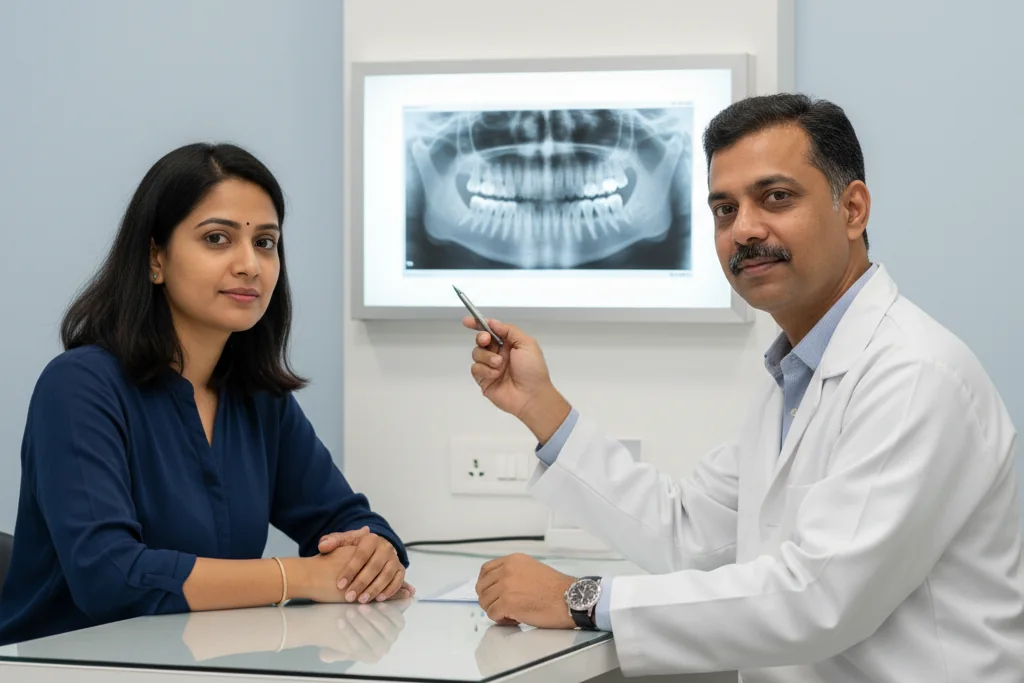
- Orthopantomogram (OPG): If the doctor suspects a broken lower jaw, they will order an OPG. This specialized panoramic dental X-ray captures the entire upper and lower jaw, the jaw joints, and all your teeth in a single image. It helps the surgeon see if the fracture line runs through the roots of your teeth.
- Vision Tests: If you have an eye socket fracture, an ophthalmologist (eye specialist) will examine the internal health of your eye to ensure the retina and optic nerve remain undamaged.
Treatment Options
The treatment for a facial fracture depends on the specific bone involved, the severity of the break, and whether the bone fragments have shifted out of place. The primary goals of treatment are to restore your normal facial appearance, ensure your teeth bite together correctly, and protect your vision and breathing.
Conservative Management
Not every facial fracture requires surgery. If the bone is broken but remains perfectly aligned in its natural position, your doctor may recommend conservative, non-surgical treatment.
- Observation and Rest: You will need to avoid any pressure on your face and refrain from physical activities or sports.
- Dietary Changes: You must follow a strict liquid or very soft diet for four to six weeks. This prevents your jaw muscles from pulling the healing bones out of alignment.
- Medications: Your doctor will prescribe pain relievers to manage discomfort and antibiotics to prevent infection, especially if the fracture connects to your mouth or sinuses.
- Cold Compresses: Applying ice packs during the first 48 hours helps reduce swelling and bruising around the eyes and cheeks.
Surgical Treatment
If the broken bones have shifted out of place, you will need surgery to realign them and hold them securely while they heal. Surgeons call this procedure Open Reduction and Internal Fixation (ORIF).
- Treating a Jaw Fracture: The surgeon will realign your jawbones so your teeth fit together perfectly. They will secure the broken bone using small titanium plates and screws. In some cases, the surgeon may need to wire your upper and lower teeth together temporarily to keep the jaw completely still. You can learn more about jaw procedures in our guide to corrective jaw surgery types and recovery.
- Treating a Cheekbone Fracture: A displaced cheekbone fracture flattens the face and restricts jaw movement. The surgeon will make small incisions, often hidden inside the mouth or in the hairline, to access the bone. They will lift the cheekbone back into its prominent position and anchor it to the surrounding stable bones using micro-titanium plates.
- Treating an Eye Socket Fracture: If an eye socket fracture traps the eye muscles or causes the eye to sink inward, surgery is essential. The surgeon will carefully access the orbital floor, usually through an incision hidden inside the lower eyelid. They will gently free the trapped tissues and place a thin titanium mesh or a specialized implant over the broken bone to support the eye.
Advanced Surgical Techniques
Modern facial trauma surgery relies heavily on technology to achieve the best cosmetic and functional results. Surgeons now use 3D virtual surgical planning before you even enter the operating room. They practice the surgery on a computer model of your face, allowing them to bend the titanium plates to the exact shape of your facial contours beforehand. This precision reduces surgery time and improves the final aesthetic outcome. These advanced planning techniques are similar to those used in complex jaw realignments, such as underbite and overbite correction.
Living with a Facial Fracture / Recovery and Outlook
Recovering from a facial fracture requires patience and strict adherence to your doctor's instructions. The bones in your face typically take about six weeks to heal completely, but the soft tissue swelling and nerve recovery can take much longer.
What to Expect After Treatment
When you wake up from surgery, you will experience significant swelling and bruising. This is a normal part of the healing process. The swelling usually peaks around the third day after surgery and then slowly subsides over the next two to three weeks. You might also feel numbness in your cheeks, lips, or gums. This happens because the trauma stretches the delicate facial nerves. The numbness usually fades gradually over several months as the nerves repair themselves.
Diet and Lifestyle Modifications
Your diet plays a important role in your recovery. Chewing generates massive force across your facial bones. To allow the plates and screws to hold the bones steady, you must avoid chewing hard foods.
- First Two Weeks: Stick to a purely liquid or blended diet. Consume smoothies, protein shakes, thin soups, and milk.
- Weeks Three to Six: Transition to a soft, "no-chew" diet. You can eat mashed potatoes, scrambled eggs, well-cooked lentils, and soft pastas.
- Physical Activity: Avoid heavy lifting, bending over, and strenuous exercise for at least a month. These activities increase blood pressure in your head and can worsen swelling. You must avoid all contact sports for at least three to six months to prevent re-injuring the healing bone.
For a detailed look at how the jaw and face heal over time, you can read our guide on orthognathic surgery recovery week by week.
Follow-Up Care and Oral Hygiene
Keeping your mouth clean is vital, especially if the surgeon made incisions inside your mouth or if you have a jaw fracture. Food particles can easily get trapped in the stitches or wires, leading to painful infections. You should gently rinse your mouth with warm salt water or a prescribed antibacterial mouthwash after every meal. Use a soft-bristled toothbrush to clean your teeth, being very careful around the surgical sites.
You will need to attend regular follow-up appointments. Your surgeon will take new X-rays to monitor the bone healing and check your bite alignment. They will also test your eye movements and facial sensation to ensure your nerves are recovering properly.
Why Choose THANC Hospital for Facial Fracture Treatment?
Treating complex facial injuries requires a deep understanding of both facial aesthetics and functional anatomy. At THANC Hospital, Dr. M. Veerabahu has decades of hands-on experience in Oral & Maxillofacial Surgery and Facial Trauma & Reconstruction. Our multidisciplinary team uses precise 3D imaging and advanced surgical planning to ensure your facial contours, bite alignment, and vision are restored accurately. If you or a loved one has suffered a facial injury, you can easily Book an Appointment for a thorough evaluation and care plan.
Frequently Asked Questions
How long does a facial fracture take to heal?
The bones in your face generally take about four to six weeks to knit back together and heal. However, the soft tissue swelling may take a few weeks to completely disappear. If you experienced nerve damage causing numbness, that specific symptom can take three to six months to fully resolve.
Will I have visible scars after facial fracture surgery?
Surgeons use specialized techniques to hide scars as much as possible. Whenever feasible, they make incisions inside the mouth, behind the hairline, or within the natural creases of your eyelids. If a skin incision is necessary, it is usually small and fades significantly over time.
Can a cheekbone fracture heal on its own without surgery?
Yes, a cheekbone fracture can heal without surgery if the bone is only cracked and has not shifted out of its normal position. Your doctor will monitor you closely and recommend a soft diet. However, if the bone is pushed inward and affects your facial appearance or jaw movement, surgery is required to push it back into place.
What should I eat while recovering from a broken jaw?
You must stick to a liquid or very soft diet to avoid putting pressure on the healing bones. Good options include nutritional shakes, blended soups, mashed potatoes, yogurt, and well-cooked oatmeal. You should completely avoid hard, crunchy, or chewy foods like nuts, raw vegetables, and tough meats for at least six weeks.
Why do I have double vision after an eye socket fracture?
An eye socket fracture can cause the thin bone under the eye to collapse, creating a hole. The fat and muscles that move your eye can fall into this hole and become trapped. When the muscles cannot move freely, your eyes do not align properly, which results in double vision.
Do the titanium plates and screws need to be removed later?
In most cases, the titanium plates and screws used to fix a facial fracture stay in your body permanently. Titanium is highly biocompatible, meaning your body does not reject it. Surgeons only remove the plates if they cause irritation, become infected, or can be felt uncomfortably right under the skin.
Learn more about Oral & Maxillofacial Surgery
View treatments, doctors & FAQs
Concerned about this condition?
Our specialists can help. Book a consultation today.
Book Consultation