
In this article
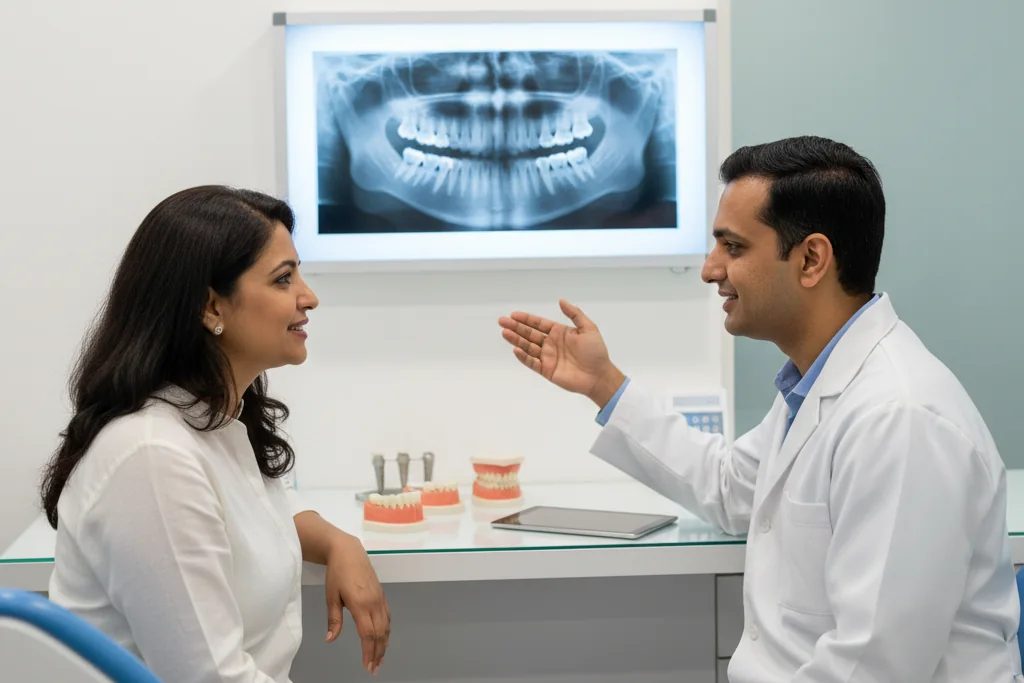
Dental Implant vs Bridge vs Denture — Making the Right Choice
Losing a tooth can feel overwhelming and stressful. You might struggle to chew your favorite foods, notice changes in your speech, or feel self-conscious when you smile. Tooth loss is a widespread issue in India. Studies show that nearly 16% of Indian adults experience complete tooth loss (edentulism), while almost half the population suffers from partial tooth loss.
Several factors contribute to these high numbers. Traditional Indian dietary habits often include frequent snacking, sugary chai, and sticky sweets that feed cavity-causing bacteria. Acidic foods like pickles, tamarind, and lemon water can wear down tooth enamel over time. Additionally, the widespread use of chewing tobacco and delayed dental visits lead to severe gum disease and eventual tooth loss.
When you lose a tooth, you lose both the visible part (the crown) and the hidden part (the root). Replacing the missing tooth is important to protect your remaining teeth, maintain your jawbone health, and restore your ability to eat and speak normally. You generally have three main options for tooth replacement: dental implants, dental bridges, and dentures.
Choosing the right solution requires careful thought. Patients often find themselves weighing an implant vs bridge or looking for a detailed implant vs denture comparison to understand what fits their lifestyle. Each option has a different approach to filling the gap in your smile.
A dental implant replaces the entire tooth structure, from the root up to the crown. A dental bridge uses your existing healthy teeth to support a false tooth in the middle. Dentures are removable false teeth that rest on top of your gums. Understanding the mechanics, benefits, and drawbacks of each method will help you make an informed decision about your oral health. You can learn more about our thorough approach to tooth replacement on our Dentistry speciality page.
How Dental Implants Work
A dental implant is the closest thing to a natural tooth that modern dentistry can provide. It involves placing a small, screw-like post made of biocompatible titanium directly into your jawbone. This titanium post acts as an artificial tooth root.
After the dentist places the implant, your jawbone slowly grows around it and fuses with the metal. This natural healing process is called osseointegration. It usually takes three to six months to complete. Once the implant bonds firmly with the bone, the dentist attaches a small connector piece called an abutment. Finally, a custom-made artificial tooth (crown) is secured onto the abutment.
You can read more about the step-by-step journey in our guide on dental implant types and what to expect.
Who It Is Best For
Dental implants are ideal for adults of all ages who have good general health and healthy gums. You need enough jawbone density to hold the implant securely. If you have lost bone due to long-term missing teeth or severe gum infections, you might need a bone grafting procedure first.
Implants are perfect for patients who want a permanent, non-removable solution that feels entirely natural. If you have lost all your teeth, you do not necessarily need an implant for every single missing tooth. Advanced techniques can support a full arch of teeth using just four or six implants. You can explore this option in our article about All-on-4 and All-on-6 implants.
For patients with severe bone loss in the upper jaw who want to avoid bone grafting, specialized implants are available. You can learn about these alternatives in our post on zygomatic and pterygoid implants.
Advantages
- Prevents bone loss: Implants stimulate the jawbone just like natural tooth roots, preventing the bone from shrinking over time.
- Protects healthy teeth: Unlike bridges, implants do not require grinding down your neighboring healthy teeth.
- Long-lasting: With proper brushing and flossing, the titanium implant can last a lifetime.
- Natural function: Implants restore full chewing power. You can comfortably eat hard Indian foods like nuts, raw vegetables, and tough meats.
- Easy maintenance: You care for an implant exactly like a natural tooth.
Limitations
- Requires surgery: The process involves a minor surgical procedure and a healing period.
- Time-consuming: The complete process from placement to the final crown can take several months.
- Health requirements: Uncontrolled diabetes or heavy smoking can slow down the healing process and increase the risk of implant failure.
How Dental Bridges Work
A dental bridge literally bridges the gap created by one or more missing teeth. It consists of an artificial tooth suspended between two dental crowns. The artificial tooth fills the empty space, while the crowns fit over the healthy teeth on either side of the gap.
To place a traditional bridge, the dentist must prepare the neighboring teeth (called abutment teeth). The dentist shaves down the enamel of these healthy teeth to create enough room for the crowns to fit over them. After reshaping the teeth, the dentist takes an impression of your mouth. A dental laboratory uses this impression to create a custom bridge that matches the color and shape of your natural teeth.
While you wait for the permanent bridge, you will wear a temporary one to protect the prepared teeth. Once the permanent bridge is ready, the dentist cements it firmly into place.
Who It Is Best For
A dental bridge is a good option for patients missing one or two consecutive teeth. It works best when the teeth on either side of the gap already have large fillings or need crowns anyway.
Bridges are also suitable for patients who want a fixed, non-removable solution but cannot undergo implant surgery. If you have medical conditions that make surgery risky, or if you lack sufficient jawbone and do not want bone grafting, a bridge offers a safe alternative.
Advantages
- Quick process: Getting a bridge usually takes only two or three weeks and requires just a couple of dental visits.
- No surgery needed: The procedure does not involve incisions, bone drilling, or long healing periods.
- Fixed securely: The bridge is cemented in place, meaning it will not slip or move while you speak or eat.
- Aesthetic improvement: A well-made bridge looks natural and immediately restores your smile.
Limitations
- Damages healthy teeth: The biggest drawback is the need to grind down perfectly healthy adjacent teeth to support the bridge.
- Bone loss continues: Because the artificial tooth rests above the gums, it does not stimulate the underlying jawbone. The bone beneath the gap will slowly shrink over time.
- Difficult to clean: Food particles and plaque can easily get trapped underneath the artificial tooth. You must use special floss threaders or water flossers to clean the area.
- Shorter lifespan: Bridges typically last 10 to 15 years before they need replacement due to wear or decay on the supporting teeth.
- When making an implant vs bridge decision, patients must weigh the faster treatment time of a bridge against the long-term bone protection of an implant.
How Dentures Work
Dentures are removable dental appliances designed to replace missing teeth and the surrounding gum tissue. They are custom-made in a dental laboratory from impressions taken of your mouth.
There are two main types of dentures. Partial dentures are used when you still have some natural teeth remaining in your upper or lower jaw. They usually consist of replacement teeth attached to a pink, gum-colored plastic base, held in place by metal clasps that grip your natural teeth.
Complete dentures are used when all the teeth in a dental arch are missing. A complete upper denture covers the roof of your mouth and relies on suction to stay in place. A complete lower denture is shaped like a horseshoe to leave room for your tongue. It rests directly on the gums and relies on gravity and your cheek muscles for stability.
Who It Is Best For
Dentures are typically recommended for patients who are missing many teeth or all of their teeth. They are often the go-to choice for older adults who have experienced significant bone loss and cannot support dental implants.
Dentures are also a practical option for patients who need an immediate replacement for missing teeth while they wait for their gums to heal after multiple tooth extractions.
Advantages
- Non-invasive: Dentures require no surgery, making them suitable for patients with complex medical conditions.
- Replaces multiple teeth: They can replace an entire arch of missing teeth at once.
- Restores facial appearance: Dentures provide support to your lips and cheeks, preventing the sunken facial appearance that occurs after severe tooth loss.
- Adjustable: Dentists can easily adjust, reline, or add new teeth to a partial denture if you lose more natural teeth in the future.
Limitations
- Removable: You must take your dentures out every night to clean them and give your gums a rest.
- Instability: Lower dentures, in particular, can slip, click, or shift while you speak or eat. Many patients need messy dental adhesives to keep them secure.
- Reduced chewing power: Dentures deliver only a fraction of the bite force of natural teeth. Eating hard, crunchy, or sticky Indian foods becomes very difficult.
- Accelerates bone loss: Dentures press down on the gums during chewing. This constant pressure actually speeds up the loss of the underlying jawbone.
- Requires frequent replacement: As your jawbone shrinks over time, the dentures will become loose. You will need to have them relined or completely replaced every five to seven years.
- In any implant vs denture comparison, dentures fall short in terms of stability, chewing efficiency, and bone preservation.
Key Differences at a Glance
When deciding on the best tooth replacement, it helps to look at how these options compare across different aspects of daily life. Here is a breakdown of the key differences:
- Durability and Lifespan:
- Implants offer a permanent solution and can last a lifetime with good oral hygiene.
- Bridges generally last 10 to 15 years before the supporting teeth experience decay or the bridge wears out.
- Dentures require relining every few years and full replacement every five to seven years as the jawbone changes shape.
- Comfort and Feel:
- Implants feel exactly like your natural teeth. You will likely forget which tooth is the implant.
- Bridges feel natural and comfortable, though you might notice the connected structure when running your tongue over them.
- Dentures can feel bulky in the mouth. Upper dentures cover the roof of the mouth, which can alter your sense of taste and temperature.
- Daily Maintenance:
- Implants require standard brushing and flossing twice a day.
- Bridges require extra effort. You must use special tools to clean the space between the gums and the artificial tooth.
- Dentures must be removed daily, brushed with a special denture cleaner, and soaked in water or a cleaning solution overnight.
- Suitability for the Indian Diet:
- Implants can handle all types of food, from tough meats to hard nuts and sticky sweets like chikki.
- Bridges can handle most foods, but you should avoid biting down on very hard items with the artificial tooth.
- Dentures struggle with hard and sticky foods. Seeds and spices can easily get trapped under the denture base, causing painful gum irritation.
Which Option is Right for You?
Choosing between an implant, a bridge, or a denture depends entirely on your unique situation. There is no single "best" option for everyone. You must consider several personal factors before making a decision.
Age and Long-Term Goals Younger patients usually benefit the most from dental implants. Because implants prevent bone loss and last a lifetime, they offer the best long-term value for someone in their twenties, thirties, or forties. Older adults might prefer the faster process of a bridge or denture, though implants remain an excellent choice for active seniors who want to eat without restrictions.
Lifestyle and Diet Think about the foods you love to eat. If your diet includes a lot of crunchy vegetables, hard nuts, or chewy breads, you need a replacement that provides maximum bite force. Implants offer the strongest chewing power. If you are comfortable eating softer foods and do not mind taking extra time to clean your teeth, a bridge or denture might suit your lifestyle.
Severity of Tooth Loss The number of teeth you are missing plays a major role in your decision. If you are missing a single tooth, an implant vs bridge comparison is the most relevant. If you are missing three or four teeth in a row, a partial denture or an implant-supported bridge makes more sense. If you are missing all your teeth, you must choose between complete dentures and full-mouth dental implants.
Overall Health and Bone Density Your medical history matters. Conditions like diabetes are highly prevalent in India and can affect how your body heals after surgery. If your diabetes is well-controlled, you can still get implants. If it is uncontrolled, a bridge or denture might be safer. Additionally, if you have suffered from severe gum disease (periodontitis), you might lack the bone density needed for implants. You will need to discuss bone grafting options with your specialist.
Talk to your specialist about your daily habits, your medical history, and what you hope to achieve with your new smile. A thorough examination is the only way to determine which treatment will work best for your specific anatomy. You can schedule a consultation with our experts by visiting our Book an Appointment page.
What We Recommend at THANC Hospital
At THANC Hospital, we believe in a strictly patient-centered approach to dental care. Dr. M. Veerabahu and our dental team do not push one single treatment option over another. Instead, we carefully evaluate your jawbone health, review your medical history, and listen to your personal preferences. We aim to educate you on all available options so you can choose the safest, most effective, and most comfortable solution for your smile.
Frequently Asked Questions
Is a dental implant painful?
No, the dental implant procedure is not painful. The dentist uses local anesthesia to completely numb the area before placing the implant. After the surgery, you might experience mild swelling and discomfort for a few days, which you can easily manage with standard pain relief medication.
How long do dental bridges last compared to implants?
Dental bridges typically last between 10 and 15 years before they need replacement due to normal wear or decay on the supporting teeth. In contrast, the titanium post of a dental implant can last a lifetime with proper care, though the crown on top might need replacement after 15 to 20 years.
Can I switch from dentures to implants later?
Yes, many patients transition from dentures to implants. However, because wearing dentures causes the jawbone to shrink over time, you might need a bone grafting procedure to rebuild the bone before the dentist can safely place the implants.
Do I need an implant for every missing tooth?
No, you do not need a one-to-one replacement. If you are missing several teeth in a row, the dentist can place two implants to support a multi-tooth bridge. If you are missing all your teeth, special techniques can support a full arch of replacement teeth using just four to six implants.
How do I clean my dental bridge?
You must brush your dental bridge twice a day just like your natural teeth. Additionally, you need to clean the space underneath the artificial tooth daily to prevent plaque buildup. You can use special floss threaders, interdental brushes, or a water flosser to keep this area clean.
Will diabetes prevent me from getting dental implants?
Having diabetes does not automatically disqualify you from getting dental implants. If your blood sugar levels are well-controlled, your healing process should be normal, and implants are highly successful. If your diabetes is uncontrolled, the risk of infection and implant failure increases, so your dentist will work with your physician to manage your condition before surgery.
Learn more about Dentistry
View treatments, doctors & FAQs
Concerned about this condition?
Our specialists can help. Book a consultation today.
Book Consultation