
In this article
Dental Implant Failure — What Could It Mean?
Getting a dental implant is a major decision and a significant investment in your oral health. When you start feeling pain, looseness, or discomfort around your new tooth, it is completely normal to feel anxious. You might immediately worry that you are experiencing a dental implant failure. However, experiencing symptoms does not always mean you will lose the implant.
To understand what might be happening, it helps to know how an implant works. A standard implant has three parts. The implant itself is a titanium post that the surgeon places into your jawbone. The abutment is a small connector piece that screws into the post. Finally, the crown is the visible artificial tooth that sits on top. Sometimes, patients feel a looseness and assume the worst, but the issue might just be a loose crown or a loose connector.
If you are dealing with a true failed implant treatment, it means the titanium post has not healed correctly within the bone, or an infection has damaged the surrounding tissue. This can happen shortly after your surgery, which doctors call an early failure. It can also happen months or even years later, which doctors call a late failure.
You should pay close attention to the specific symptoms you feel. Common warning signs include sharp pain when you chew your food. You might also notice swollen, red, or bleeding gums around the artificial tooth. In more severe cases, you might see pus draining from the gums, or you might feel the entire metal post shifting when you touch it with your tongue.
Whatever symptoms you experience, you must acknowledge the problem early. Ignoring the signs will only allow the underlying issue to worsen. The sooner a dental professional examines your mouth, the higher the chance they can fix the problem and save your smile.
Common Causes of Dental Implant Failure
When you visit the clinic with implant discomfort, the dental team will look for a variety of causes. They will always check for the most common and easily fixable problems first before investigating more serious biological issues.
The most benign cause of a wobbly implant is a mechanical issue. The tiny screw that holds the abutment to the titanium post can loosen over time due to the daily pressure of chewing. Similarly, the dental cement holding the crown in place can wash away. In these cases, the implant itself remains solidly fused to your jawbone. The dentist simply needs to tighten the screw or reattach the crown.
If the issue is not mechanical, the doctor will look for biological causes. The most critical process in implant surgery is osseointegration. This is the biological process where your natural bone cells grow around and fuse with the titanium threads of the implant. If your body fails to complete this process, a layer of soft scar tissue forms instead of solid bone. This prevents the implant from locking into place, leading to early dental implant failure.
Another major cause of a failed implant treatment is a condition called peri-implantitis. This is a destructive bacterial infection of the gums and bone surrounding the implant. Plaque and tartar build up around the base of the crown, pushing the gums away and creating deep pockets. Bacteria breed in these pockets and slowly eat away at the jawbone supporting the implant.
Several systemic and lifestyle factors significantly increase your risk of experiencing these complications. In India, specific health and cultural factors play a major role in implant success rates:
- Diabetes: According to the Indian Council of Medical Research (ICMR), over 10.1 crore people in India live with diabetes. High blood sugar stiffens your blood vessels and reduces blood flow to your gums. This slows down the healing process and makes it much harder for your body to fight off bacterial infections.
- Tobacco and Paan Use: Using tobacco is one of the biggest risk factors for implant complications. Smoking cigarettes introduces toxic chemicals and heat into the mouth. Furthermore, chewing smokeless tobacco products like paan, gutkha, and khaini severely damages the gum tissue. These products contain harsh chemicals that restrict blood flow and abrasive particles that physically irritate the healing gums.
- Poor Bone Density: Research shows that implants placed in softer, less dense bone have a higher failure rate. Doctors refer to this soft bone as Type IV bone, and it is most commonly found in the upper back sections of the jaw.
- Teeth Grinding (Bruxism): Many people unconsciously clench or grind their teeth, especially during sleep. This puts massive pressure on the implant before the bone has fully healed, which can break the delicate new bone cells trying to fuse with the metal post.
- Poor Oral Hygiene: Just like natural teeth, implants require daily brushing and flossing. Failing to keep the area clean allows destructive bacteria to thrive.
If you are currently exploring your options for replacing missing teeth and want to understand how different choices affect your oral health, you can read our guide comparing a dental implant vs bridge vs denture.
When to See a Doctor
You should never ignore pain or changes in your mouth after undergoing implant surgery. While some mild soreness is normal in the first few days after the procedure, persistent or worsening symptoms require professional attention. Knowing when to seek help can make the difference between saving the implant and losing it entirely.
You should schedule an appointment with your dentist within a week if you notice mild but persistent issues. For example, if your gums look slightly red or puffy around the implant, you should get it checked. If you feel a slight clicking sensation when you chew, or if the crown feels a little loose, call your clinic. These early warning signs often point to minor mechanical issues or early-stage gum inflammation that the doctor can easily treat.
However, certain symptoms require immediate medical attention. You should contact your dental clinic right away if you experience any of the following red-flag symptoms:
- Severe, throbbing pain that keeps you awake at night or does not improve with pain medication.
- Visible pus or a foul-tasting discharge oozing from the gums around the implant.
- The implant feels completely loose and moves visibly when you touch it with your finger or tongue.
- Sudden, heavy bleeding from the surgical site that does not stop when you apply gentle pressure.
In rare cases, an infection from a failed implant treatment can spread beyond your mouth and become a medical emergency. You must go to the nearest hospital emergency room immediately if you experience severe warning signs. These include swelling that spreads rapidly down your neck or up toward your eye. You should also seek emergency care if you develop a high fever over 101°F (38.3°C), or if you have any difficulty swallowing or breathing. These symptoms indicate a spreading infection that requires urgent medical intervention.
What to Expect at Your Appointment
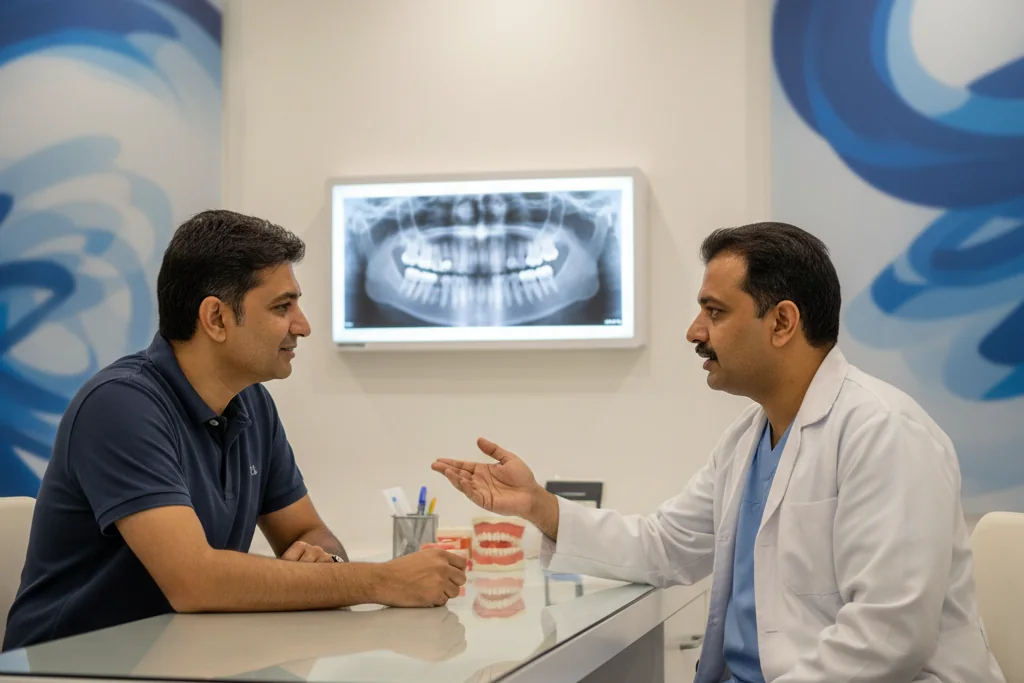
When you arrive at the clinic with concerns about your implant, the dental team will focus on finding the exact root cause of the problem. They will conduct a thorough investigation to determine whether the issue is mechanical, biological, or related to your overall health.
The appointment will begin with a detailed conversation. The doctor will ask you several questions about your symptoms and medical history. They will want to know exactly when the pain or looseness started and whether it has gotten worse over time. They will also ask about your daily habits, including how often you brush and whether you use any tobacco products like cigarettes or paan. If you have diabetes, the doctor will ask about your recent blood sugar readings.
Next, the doctor will perform a careful physical examination of your mouth. They will visually inspect the gums around the implant for signs of redness, swelling, or receding tissue. The dentist will use a smooth metal instrument to gently tap the implant crown. A healthy, fully integrated implant makes a solid, high-pitched ringing sound, while a failing implant often makes a dull thud. They will also use a small measuring tool called a periodontal probe to check the depth of the gum pockets around the implant. Deep pockets usually indicate bone loss and infection.
To see what is happening beneath the gums, the doctor will order specific tests. You can expect the following diagnostic steps:
- Dental X-rays: Standard X-rays help the doctor see the bone levels immediately surrounding the titanium post. They can spot areas where the bone has melted away due to infection.
- CBCT Scan: A Cone Beam Computed Tomography scan provides a highly detailed, 3D view of your jawbone, nerves, and sinus cavities. This helps the doctor assess the exact volume and density of the remaining bone.
- Blood Tests: If the doctor suspects that an underlying health issue is slowing your healing, they may request blood tests. They will often ask for an HbA1c test to check your long-term blood sugar control.
The goal of this thorough evaluation is to create a precise treatment plan. To learn more about the different specialists who handle these complex evaluations, you can explore our Dentistry department page.
Treatment Options Based on the Cause
Once the doctor identifies the cause of your symptoms, they will explain your treatment options. The approach depends entirely on whether the problem is a simple mechanical failure or a complex biological issue. The primary goal is always to save the implant if possible, but the doctor will prioritize your overall jaw health.
If the examination reveals a mechanical issue, the treatment is usually quick and painless. If the crown has come loose, the dentist will clean the area and reattach the crown using fresh dental cement. If the abutment screw has loosened, the dentist will carefully remove the crown, tighten the tiny screw inside the implant, and replace the crown. You will usually feel immediate relief once the pieces are secure.
If you have an early-stage infection, the doctor will focus on eliminating the bacteria before it damages the bone. They will thoroughly clean the area around the implant and prescribe a course of oral antibiotics. They will also give you a special antibacterial mouthwash containing chlorhexidine to use at home. With prompt treatment, the gums will heal, and the implant will remain secure.
When a patient develops peri-implantitis, the treatment becomes more complex. The dentist must perform a deep cleaning procedure called debridement. During this procedure, the doctor numbs your gums and uses special titanium or plastic instruments to scrape away the hardened tartar from the implant threads. They may also use laser therapy to gently vaporize the bacteria hiding deep within the gum pockets. If the infection has already destroyed some of the surrounding bone, the doctor might perform a bone graft. They will place tiny granules of sterilized bone material around the implant to encourage your body to rebuild the lost support.
Unfortunately, if the implant has completely failed to fuse with the bone or if the infection has destroyed too much support, the doctor must remove the implant. Removing a failed implant is usually much easier than extracting a natural tooth because the bone has already pulled away from the metal post. The doctor will numb the area, gently unscrew the loose implant, and thoroughly clean out all the infected tissue.
After removing the implant, the doctor will usually pack the empty hole with bone graft material to preserve the shape of your jaw. You will then need to wait 3 to 6 months for the bone to heal completely. During this time, you can wear a temporary tooth so you do not have a gap in your smile. Once the bone is strong and healthy again, you can usually try the implant procedure a second time.
To understand the steps involved in a successful procedure, you can read our detailed guide on dental implant types and what to expect. If you have experienced multiple failures or have severe bone loss, the doctor might discuss alternative approaches, such as All-on-4 or All-on-6 implants for full mouth restoration.
Home Care and First Aid
If you suspect you are experiencing a dental implant failure, you must schedule a professional evaluation. However, there are several steps you can take at home to manage your symptoms and protect the area while you wait for your appointment. Proper home care can prevent an infection from getting worse and keep you comfortable.
The most effective thing you can do right now is to keep the area as clean as possible without causing further irritation. You should mix half a teaspoon of salt into a glass of warm water and rinse your mouth gently for 30 seconds. Salt water creates an environment where bacteria struggle to survive, and it helps soothe inflamed gums. You can repeat this rinse three to four times a day, especially after eating.
You must also adjust your diet to protect the implant. Eat only soft foods that require minimal chewing. Traditional Indian foods like idli, upma, khichdi, dal, and yogurt are excellent choices. You should consciously chew all your food on the opposite side of your mouth to avoid putting any pressure on the failing implant. If you are experiencing swelling, you can apply a cold compress or an ice pack wrapped in a cloth to the outside of your cheek for 15 minutes at a time.
While waiting for your appointment, there are several things you must strictly avoid:
- Do not wiggle or push the implant with your fingers, tongue, or a toothbrush. Moving the implant will tear the delicate healing tissues and worsen the damage.
- Stop using all tobacco products immediately. Do not smoke cigarettes or chew paan, gutkha, or khaini. These products choke off the blood supply your gums desperately need to heal.
- Avoid hard, crunchy, or sticky foods like chikki, tough meats, or crunchy murukku.
- Do not place aspirin or any other painkiller directly on your gums. This is a common misconception that causes severe chemical burns on the soft tissue. You should swallow pain medication with water as directed on the package.
Remember that home care and first aid are only temporary measures. Home remedies cannot cure a failed implant treatment or reverse bone loss. If your symptoms persist or worsen, you must see a dental specialist.
Why See a Specialist at THANC Hospital?
When dealing with a failing dental implant, you need an accurate diagnosis and a precise treatment plan to protect your jawbone. The dental specialists at THANC Hospital in Kilpauk, Chennai, have extensive experience in managing complex implant complications. They use advanced imaging technology to see exactly what is happening beneath your gums and determine the best course of action.
Dr. M. Veerabahu is a highly trained Oral & Maxillofacial Surgeon with deep expertise in complex dental implant surgery, bone grafting, and jaw reconstruction. His background in treating severe facial trauma and jaw tumors gives him a profound understanding of bone biology and healing. Whether you need a simple adjustment, a complex bone graft, or a complete implant replacement, the team at THANC Hospital provides compassionate, expert care. If you are experiencing implant issues, get it checked before the problem gets worse. You can easily Book an Appointment to get your smile back on track.
Frequently Asked Questions
Can a failed dental implant be saved?
Yes, doctors can often save a failing implant if you catch the problem early. If the issue is a loose crown or a minor gum infection, the dentist can tighten the components or clean the area to restore health. However, if the implant is completely loose and the bone has severely deteriorated, the doctor must remove the implant to clear the infection.
Does it hurt when a dental implant fails?
It does not always hurt when an implant fails. Sometimes, the only sign of a problem is a slight wobbly feeling when you chew. Other times, especially if a bacterial infection is present, you may experience sharp, throbbing pain, swollen gums, and a bad taste in your mouth.
How do I know if my implant is failing or just healing?
Normal healing involves mild soreness and slight swelling that steadily improves every day after your surgery. A failing implant causes symptoms that get worse over time instead of better. If you experience new pain weeks after the surgery, sudden swelling, or a loose feeling in the tooth, your implant is likely failing.
Can I get another implant if the first one fails?
Yes, you can usually get a new implant after a failure. Once the doctor removes the failed implant, they will clean the infection and place a bone graft to rebuild your jaw. After the bone heals completely over 3 to 6 months, the doctor can place a new implant, which generally has a very high success rate.
How long does it take to recover from a failed implant removal?
The soft gum tissue usually heals within 1 to 2 weeks after the doctor removes the failed implant. However, the bone underneath takes much longer to recover. You will typically need to wait 3 to 6 months for the bone graft to solidify and create a strong foundation before you can attempt a new implant surgery.
Does chewing paan affect my dental implants?
Yes, chewing paan and gutkha significantly increases your risk of implant failure. These smokeless tobacco products contain harsh chemicals that restrict blood flow to your gums, preventing the bone from healing around the implant. The abrasive pieces in paan also physically damage the gum tissue, making it much easier for severe infections to take hold.
Learn more about Dentistry
View treatments, doctors & FAQs
Concerned about this condition?
Our specialists can help. Book a consultation today.
Book Consultation